10 Dramatic Moody Kitchen Ideas That Transform Your Cooking Space
There is something quietly powerful about a kitchen that refuses to be bright and breezy. Moody kitchen ideas have surged to the forefront of interior design, offering a sophisticated alternative to sterile white cabinetry and clinical finishes. These are spaces that feel lived-in, layered, and deeply intentional — kitchens where shadow is as important as light, and where every material choice tells a story. Whether you are drawn to deep forest greens, midnight blues, or near-black charcoals, a moody kitchen can be tailored to your personality while remaining supremely functional. In this article, we explore ten distinct moody kitchen design concepts — from period-home renovations dripping in heritage detail to compact apartment layouts that prove drama doesn’t require square footage. Each one is a masterclass in atmosphere, texture, and restraint.
1. Charcoal and Brass: The Classic Dark Kitchen Statement
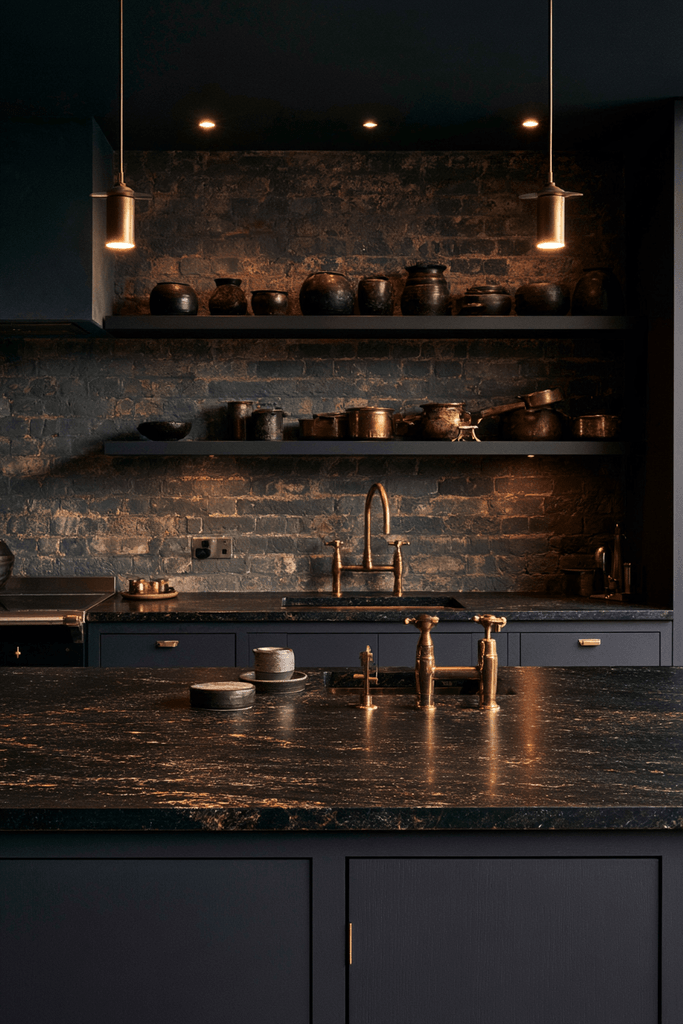
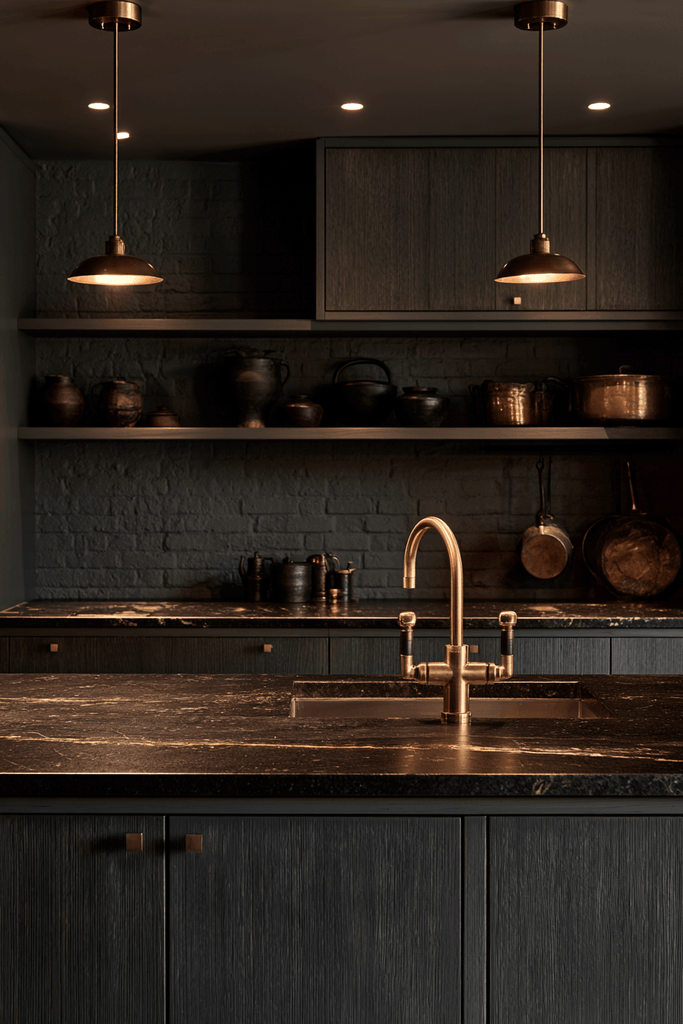
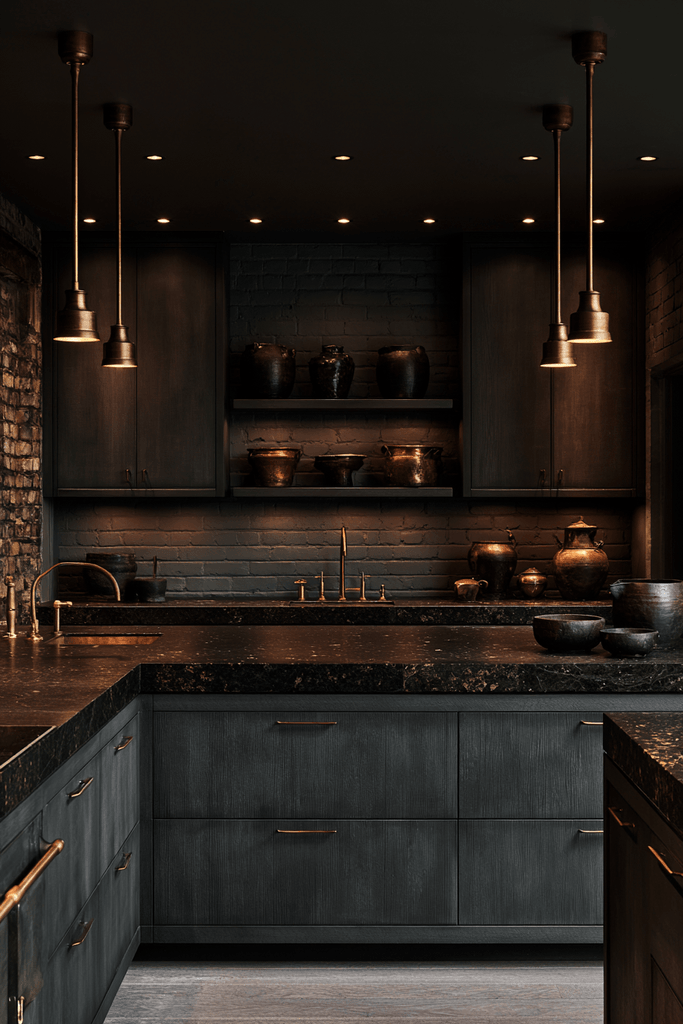
Few combinations in interior design carry the same quiet authority as dark charcoal cabinetry paired with warm brass fixtures. In this design, matte-finish charcoal cabinets absorb light rather than reflect it, creating a sense of depth that draws the eye inward. Black granite countertops with subtle gold veining echo the brass hardware overhead, unifying the palette through metallic continuity. Recessed pendants cast pools of warm amber light, while exposed brick walls — painted in deep slate — add a raw, textural counterpoint to the polished surfaces. Open shelving styled with dark ceramic vessels and aged copper cookware turns storage into a curated display, lending the space a gallery-like intentionality.
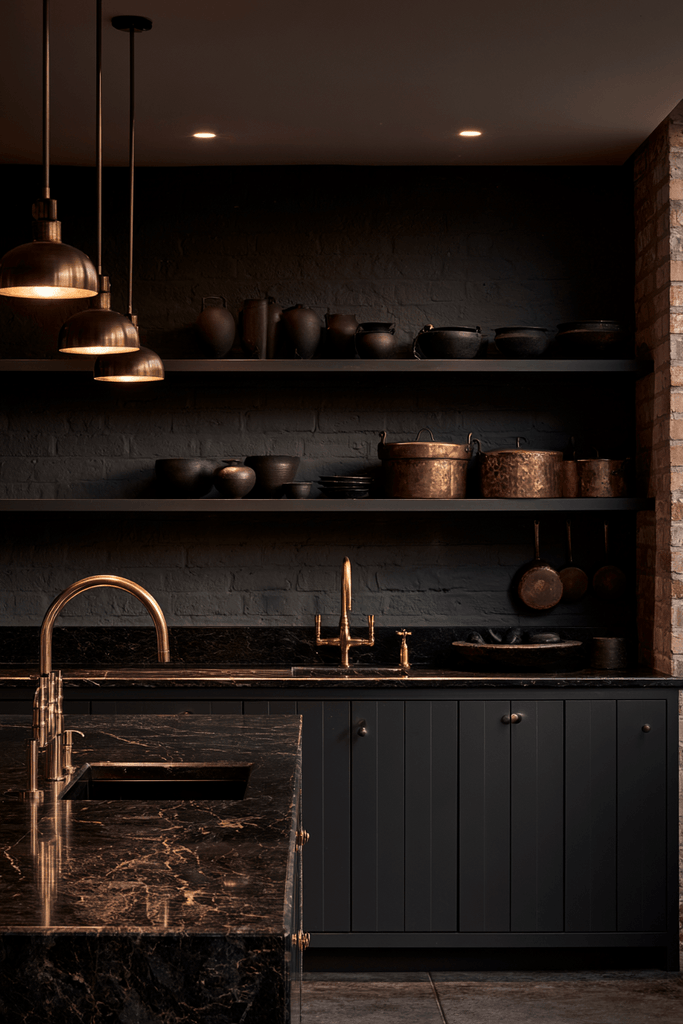
- Choose matte cabinet finishes to prevent harsh reflections and deepen the sense of shadow.
- Layer your metals — brass fixtures, copper accents, and gold-veined stone create warmth without clashing.
- Use recessed pendant lighting to control exactly where light falls, keeping corners atmospheric.
- Style open shelving deliberately — limit colour to two or three tones for a cohesive, editorial look.
- Paint exposed brick in deep tones rather than leaving it raw to integrate it into a unified moody palette.
2. Forest Green Shaker Cabinets With Farmhouse Soul
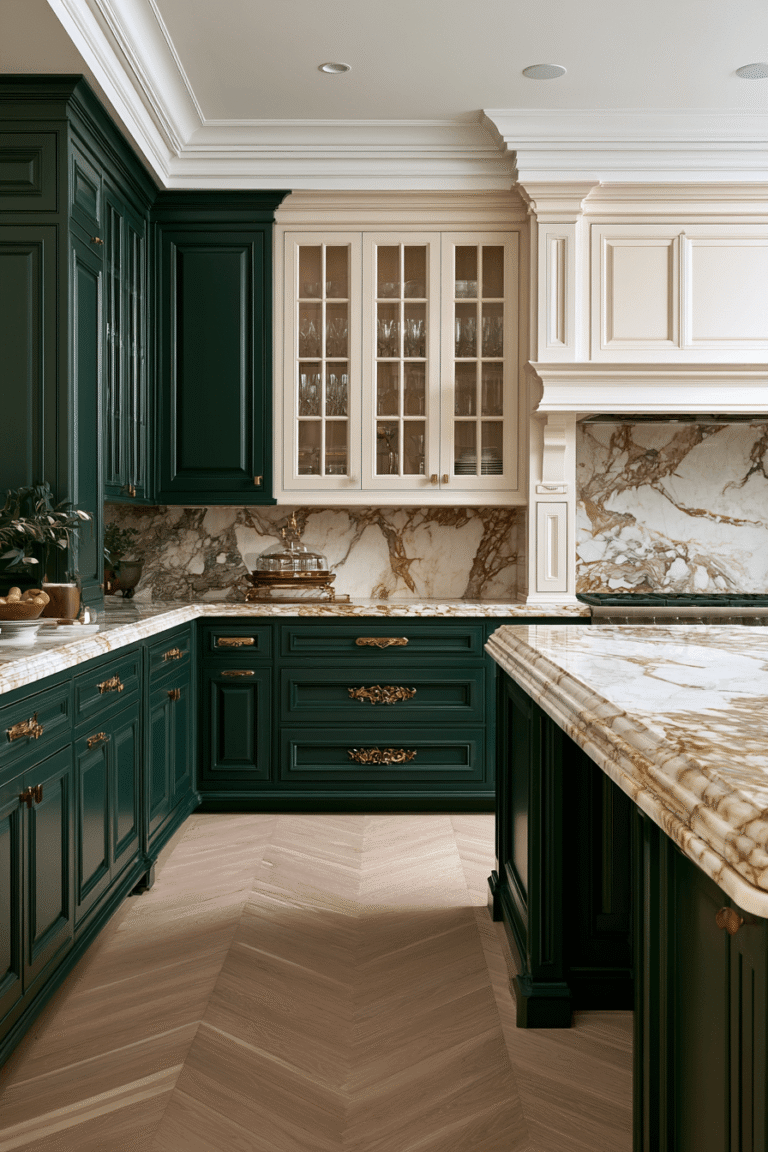
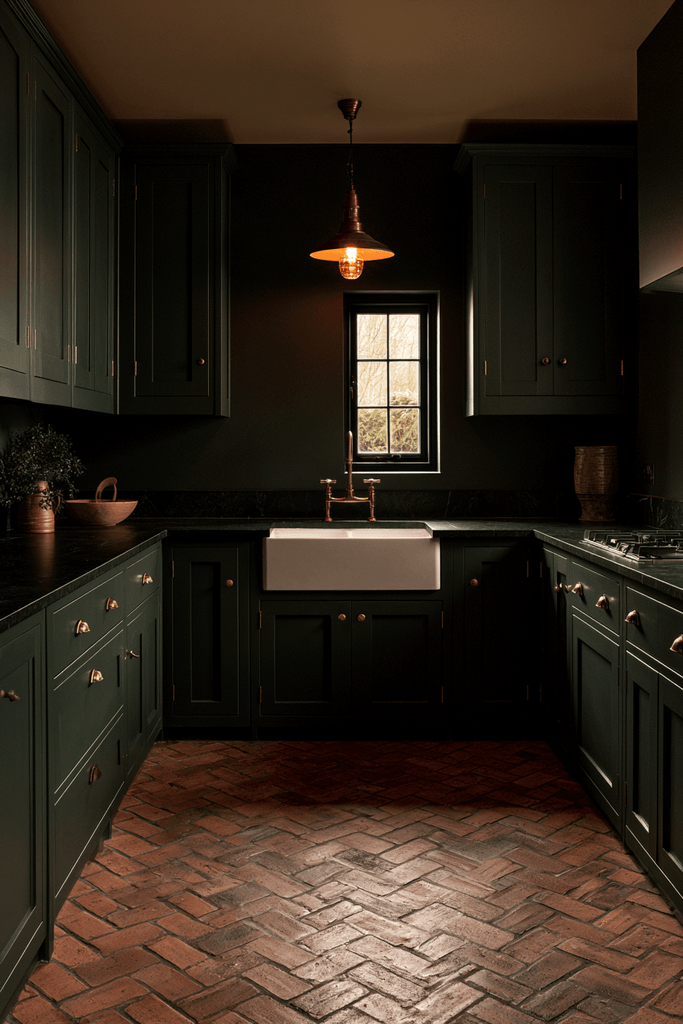
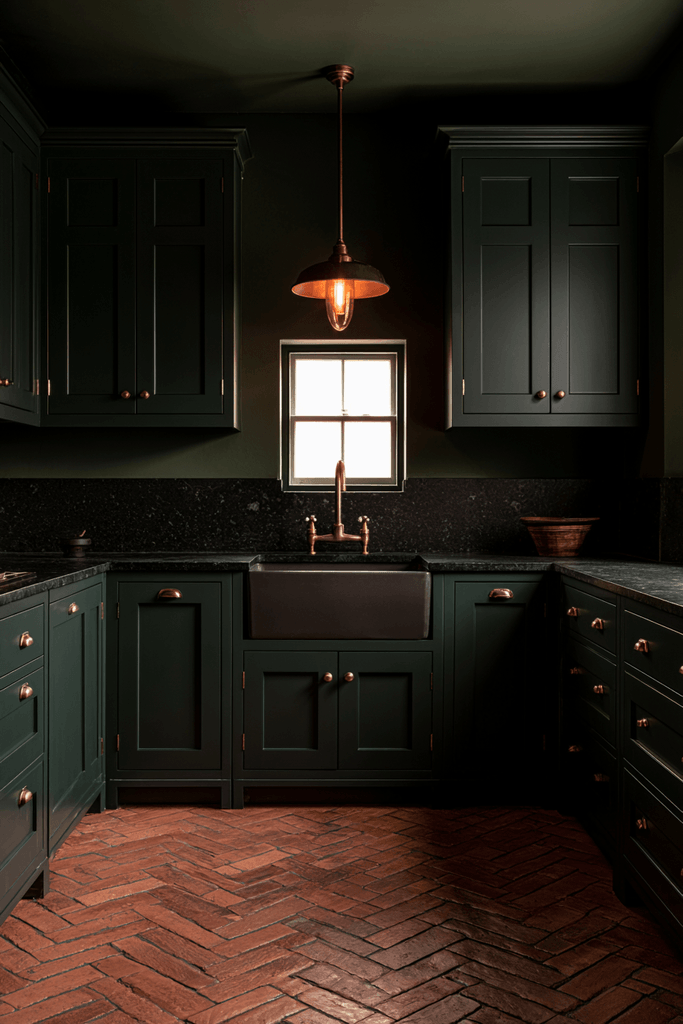
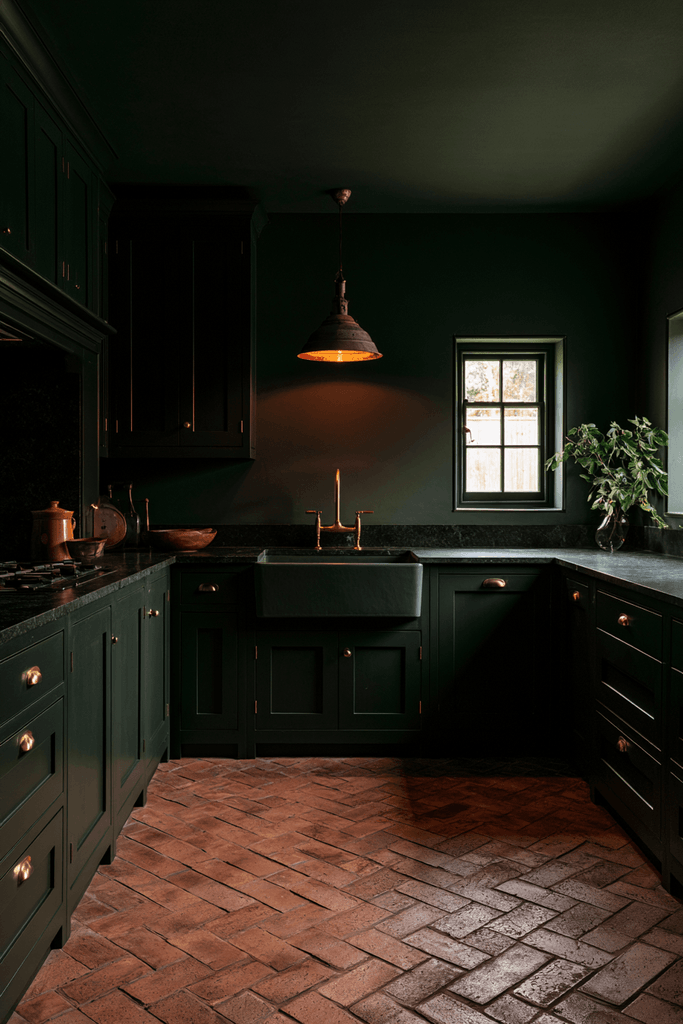
Deep forest green is one of the most versatile colours in the moody kitchen toolkit — organic enough to feel earthy, saturated enough to feel bold. Here, classic shaker cabinets in forest green are paired with unlacquered brass hardware that will develop a natural patina over time, growing more characterful with every passing year. Honed black soapstone countertops bring a cool, matte weight to the design, while herringbone terracotta floor tiles introduce warmth underfoot — a deliberate tension that keeps the space from feeling cold. A deep farmhouse sink anchored beneath a single industrial pendant in warm amber creates a focal point of almost meditative calm. Dusk light filtering through a small window completes the tableau, softening the greens into something that feels almost forest-like at golden hour.
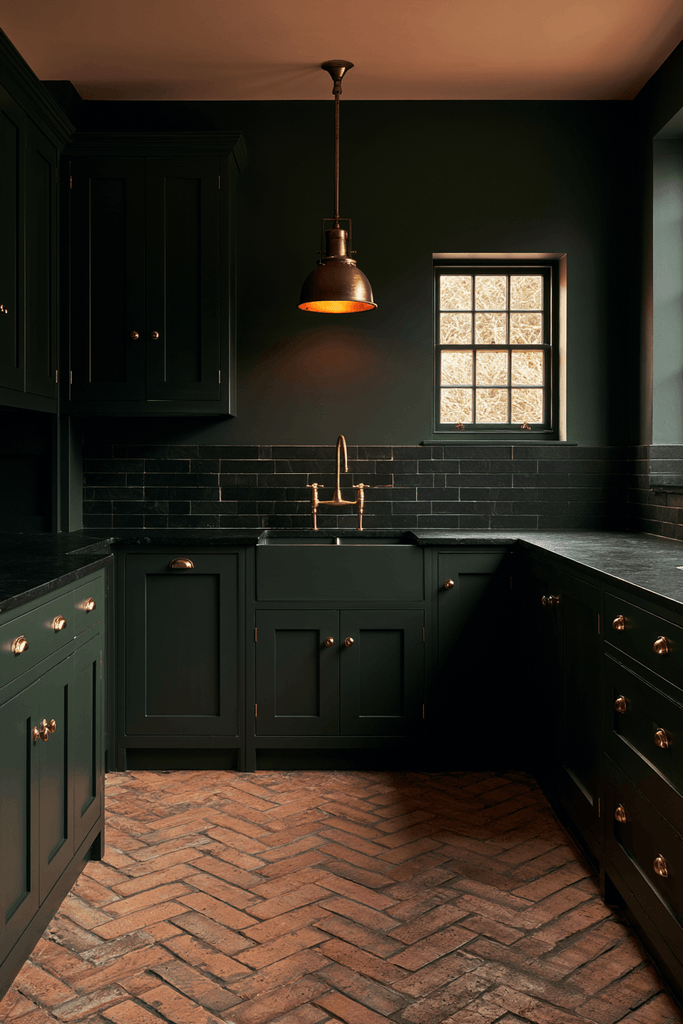
- Select unlacquered brass over lacquered alternatives — the patina it develops over time adds irreplaceable authenticity.
- Use honed stone countertops rather than polished; the matte surface absorbs light and reinforces the moody quality.
- Introduce terracotta flooring in herringbone format to add pattern and warmth without disrupting the dark palette.
- Opt for a single strong pendant over multiple small lights — visual simplicity amplifies drama.
- Keep window treatments minimal so natural dusk light can do its atmospheric work unimpeded.
3. Navy Island With Zellige Tile Backsplash and Edison Warmth
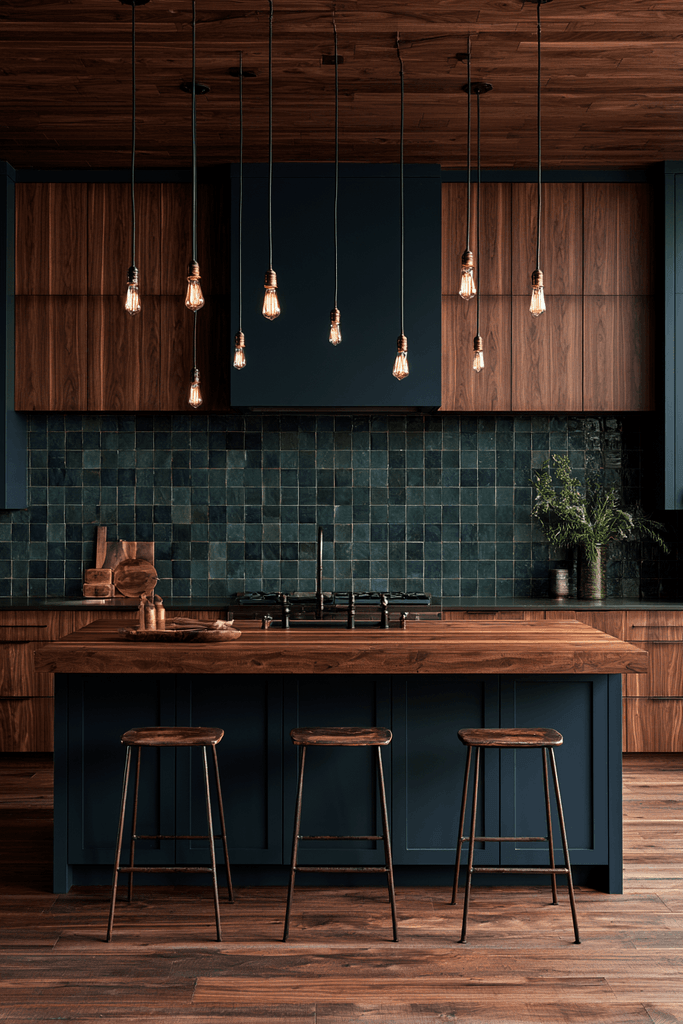
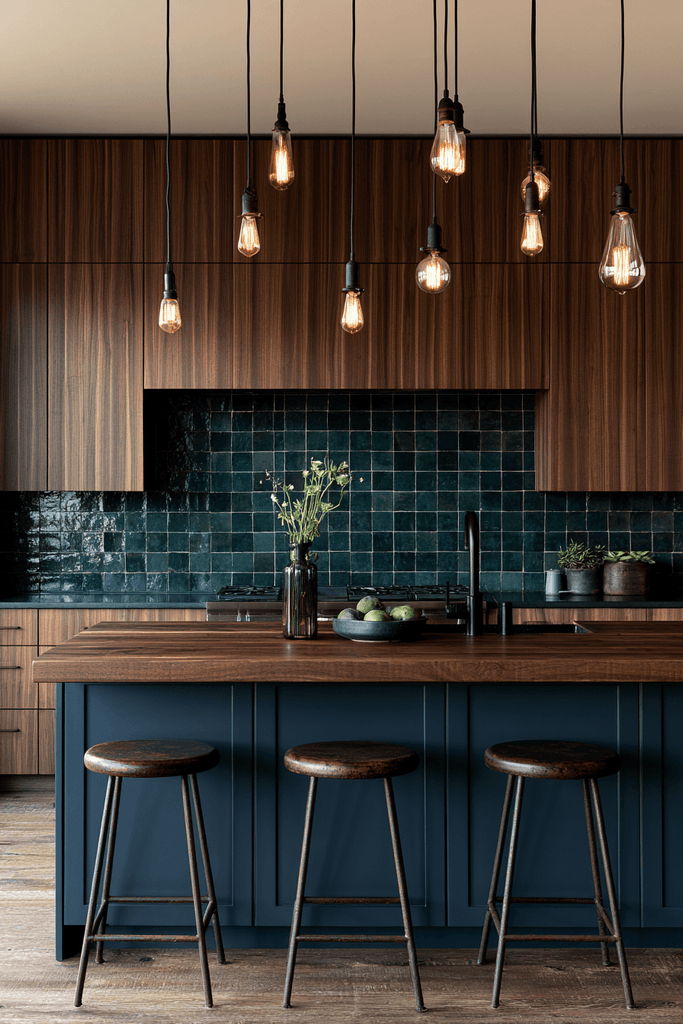
This design revolves around contrast and texture working in harmony. A navy blue island with a thick butcher block top anchors the space, its organic wood surface warming the otherwise cool blue cabinetry. Near-black walnut veneer cabinets on the perimeter create a tonal envelope that makes the island feel like a jewel at the centre of the room. The real visual coup is the backsplash: handmade zellige tiles in deep teal, each one slightly irregular in glaze and form, catching the warm glow of vintage Edison bulb pendants hung at varied heights. The layering of blue, teal, and warm tungsten light produces a colour shift that changes throughout the day — cooler in morning light, richer and more amber by evening.
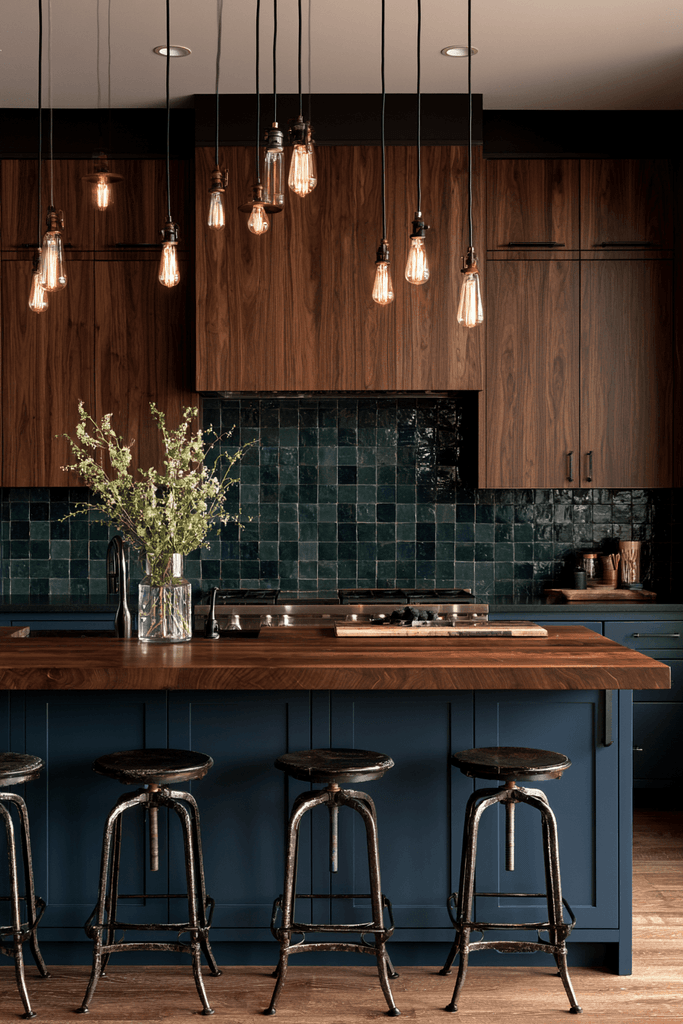
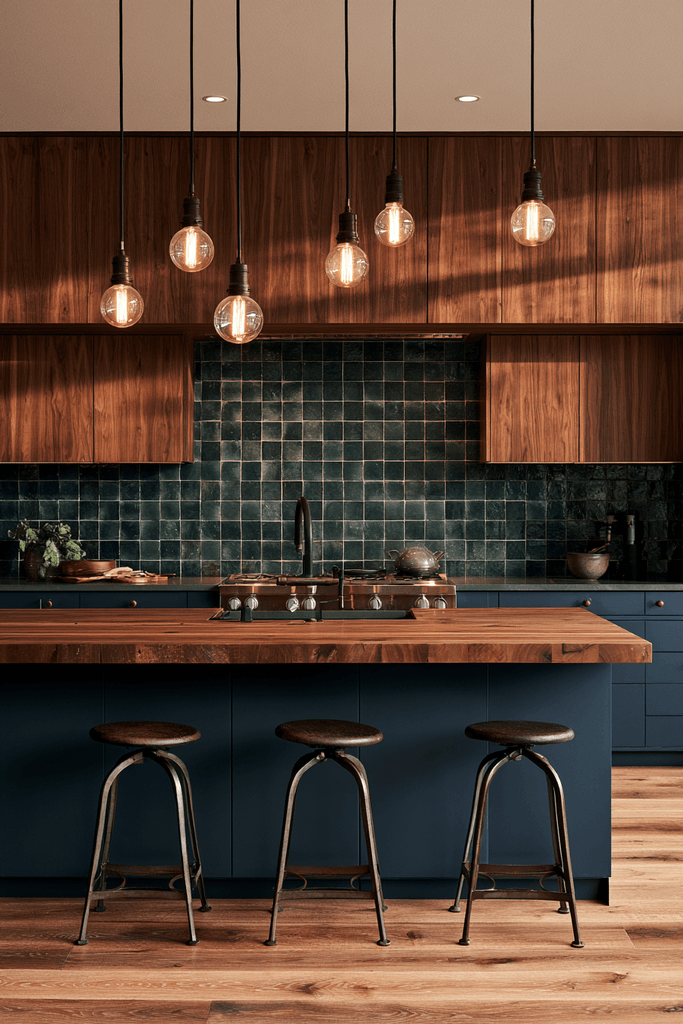
- Use butcher block on a dark island to introduce natural warmth and prevent the palette from feeling too heavy.
- Choose handmade zellige tiles over factory-produced alternatives — the variation in glaze creates authentic depth.
- Hang pendants at varied heights above an island to create a sculptural, asymmetric light installation.
- Layer blue and teal tones in cabinetry and tile — analogous colour combinations in moody kitchens feel sophisticated rather than chaotic.
- Select walnut veneer for perimeter cabinets to frame the space and add richness through natural wood grain.
4. Smoked Glass Uppers and Leathered Marble: The Refined Moody Kitchen
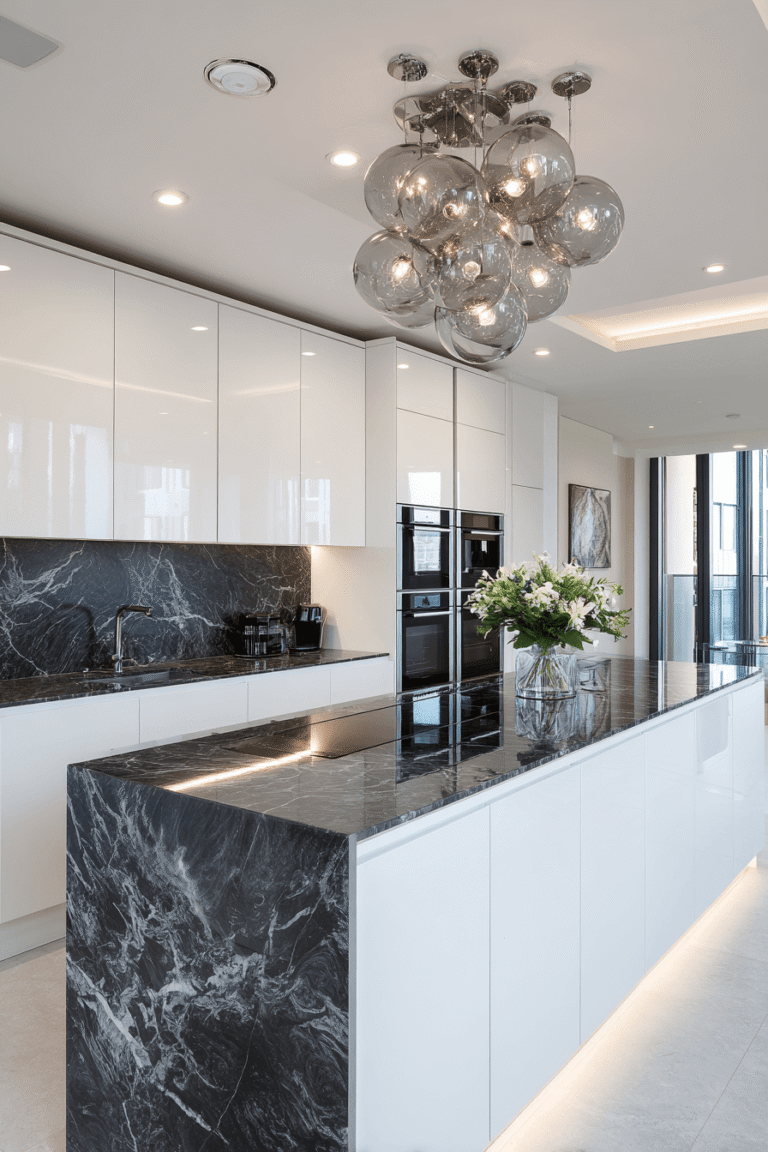
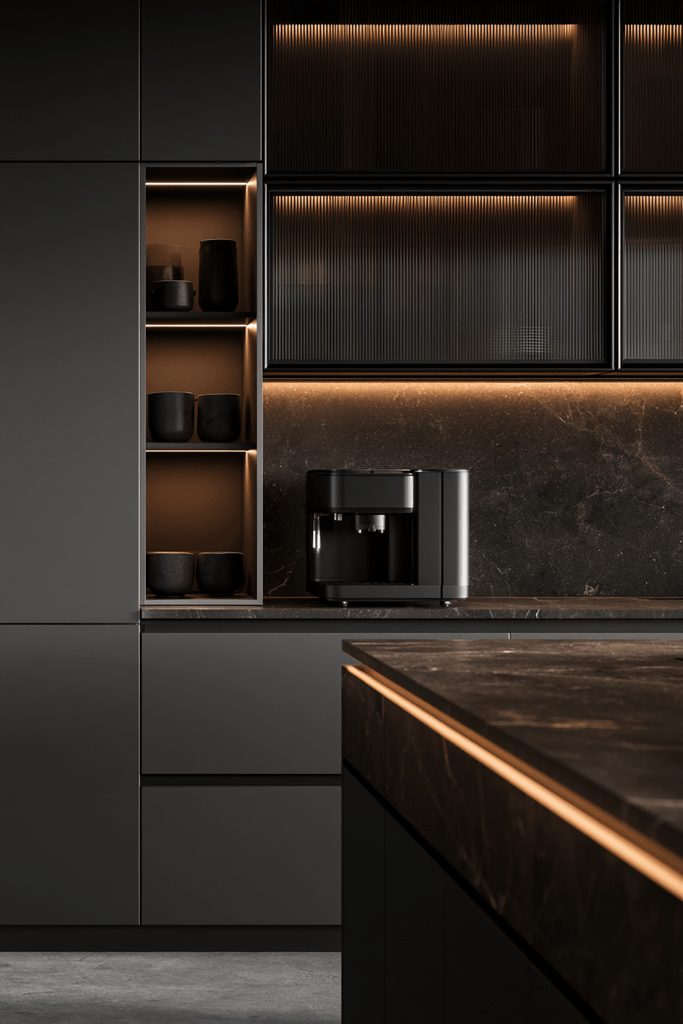
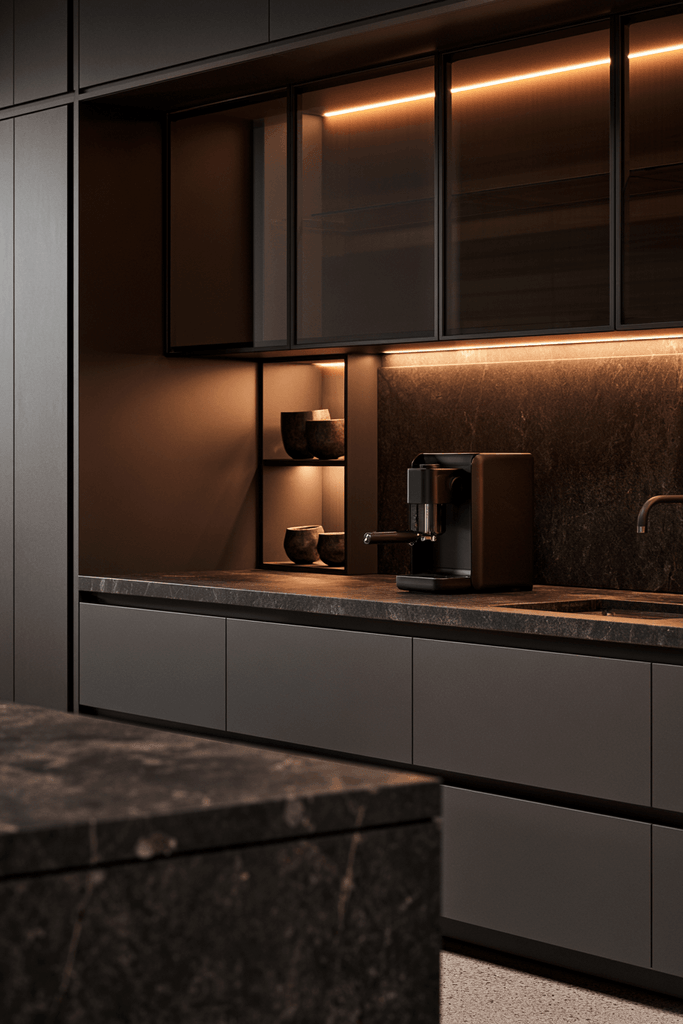
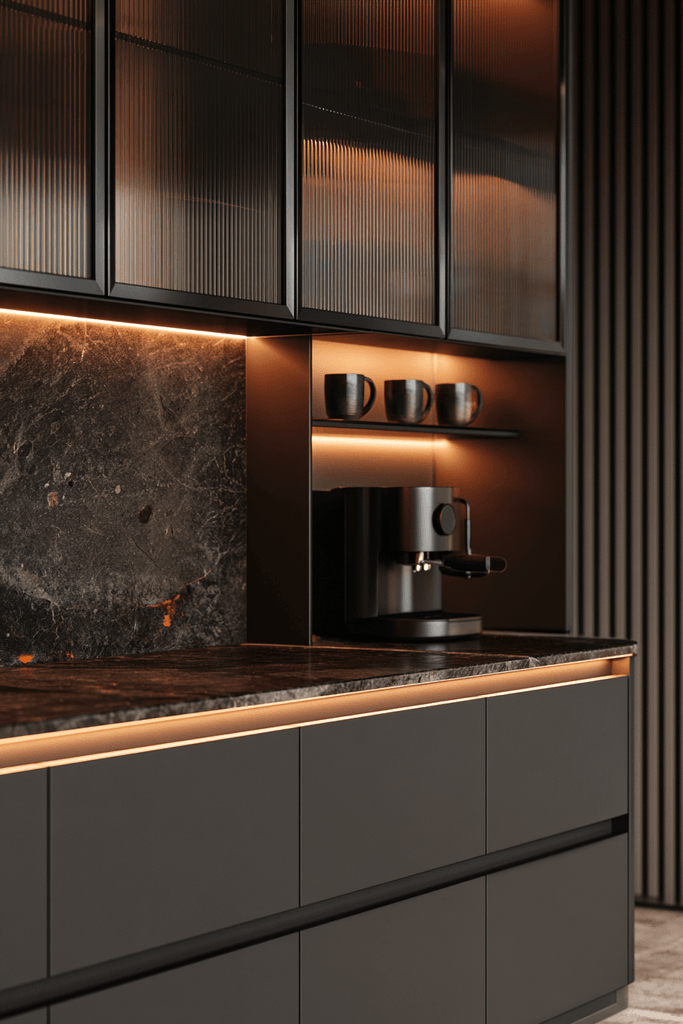
Where some moody kitchens lean into raw industrial energy, this design pursues a more refined, editorial luxury. Two-tone cabinetry pairs upper cabinets in smoked glass with lower cabinets in matte graphite — a combination that feels sleek without sacrificing warmth. Leathered black marble countertops, with their subtly textured surface and visible natural imperfections, reject the idea of perfection in favour of authenticity. A slim built-in coffee bar niche — stocked with dark glazed mugs and a matte black espresso machine — adds functional purpose while maintaining the colour discipline of the overall design. Warm amber LED strips beneath upper cabinets illuminate the workspace without disrupting the moody atmosphere above.
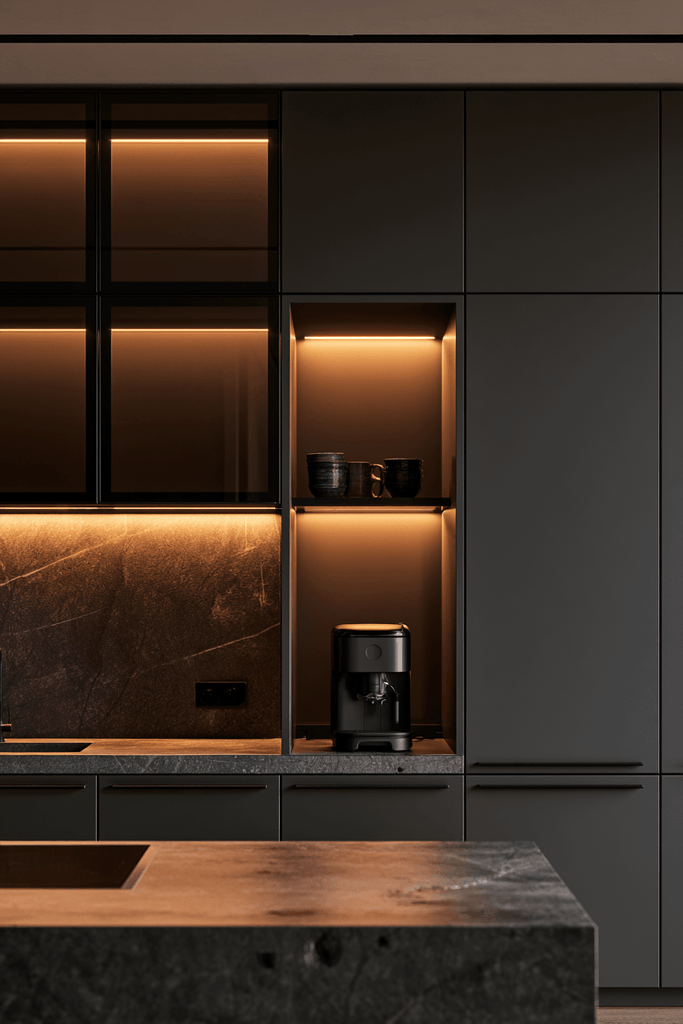
- Choose leathered marble finishes over polished — the texture catches light differently and hides everyday marks beautifully.
- Build in a coffee bar niche to add a bespoke, furniture-like quality to your kitchen cabinetry.
- Match appliances to the palette — matte black espresso machines and fixtures maintain visual cohesion.
- Use smoked glass upper cabinets to break up solid cabinetry runs while partially concealing stored items.
- Install warm-toned under-cabinet LEDs at low intensity to illuminate surfaces without washing out the shadow play above.
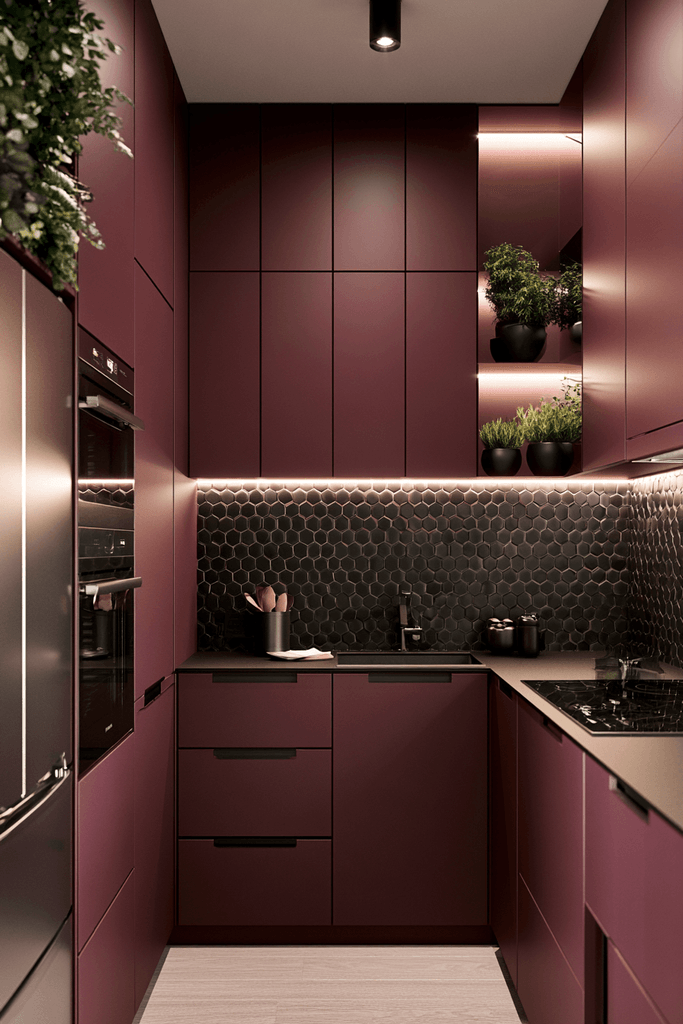
5. Burgundy Galley Kitchen With Mirrored Backsplash Drama
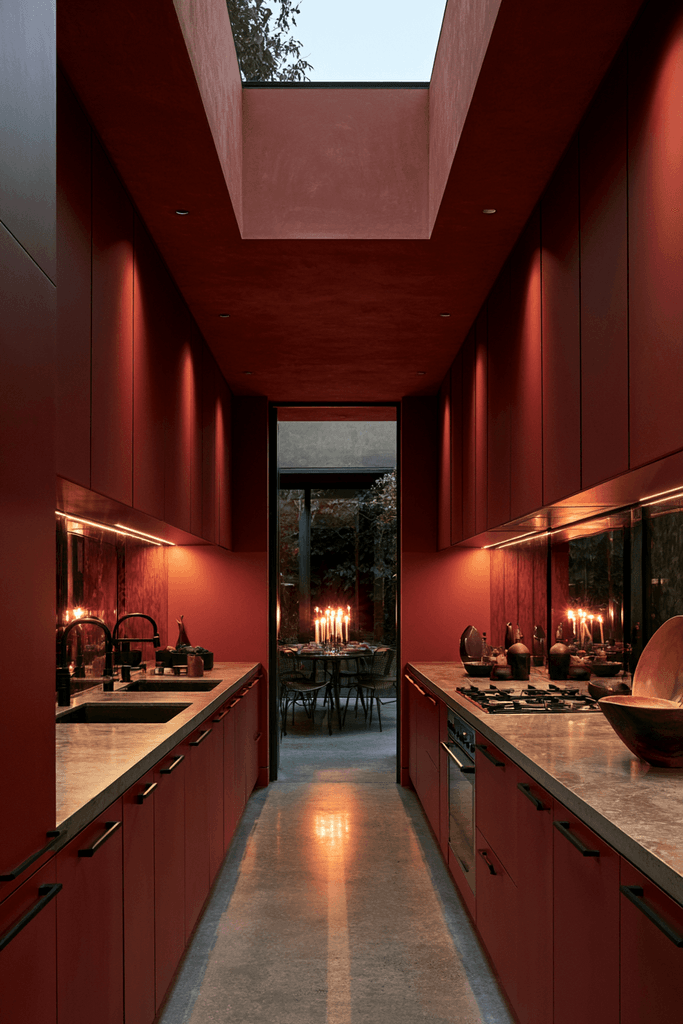
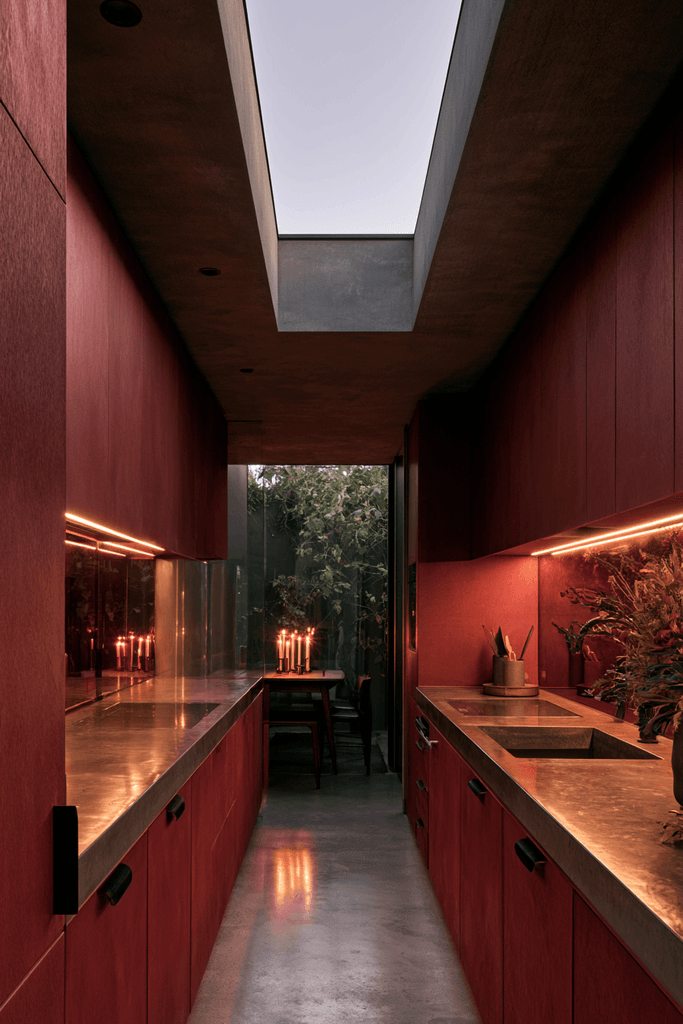
A galley kitchen in deep burgundy red sounds audacious — and it is, in the most rewarding way. Floor-to-ceiling cabinetry in this saturated hue creates an immersive tunnel of colour, transformed rather than overwhelmed by polished concrete countertops that offer a cool, industrial counterpoint. The masterstroke is the mirrored glass backsplash, which reflects candlelight from a nearby dining nook, doubling the sense of warmth and making the narrow galley appear twice its actual depth. Matte black pulls and fixtures run consistently throughout, acting as punctuation marks that give the eye rhythm and rest. A skylight above introduces cool daylight that plays against the warm cabinetry tones, creating a dynamic interplay of warm and cool that shifts beautifully throughout the day.
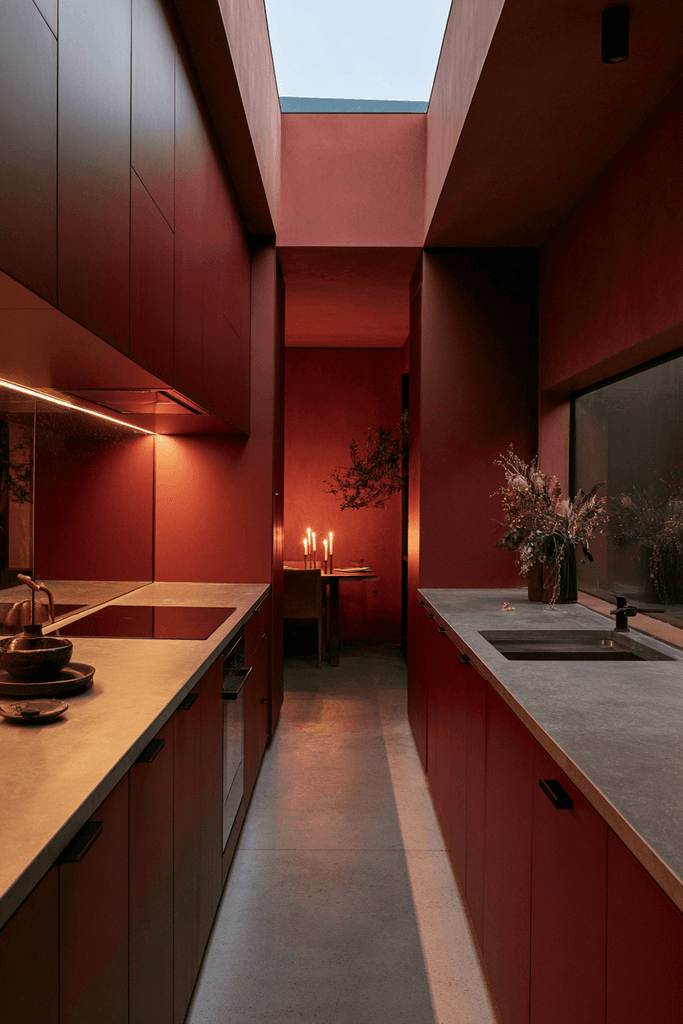
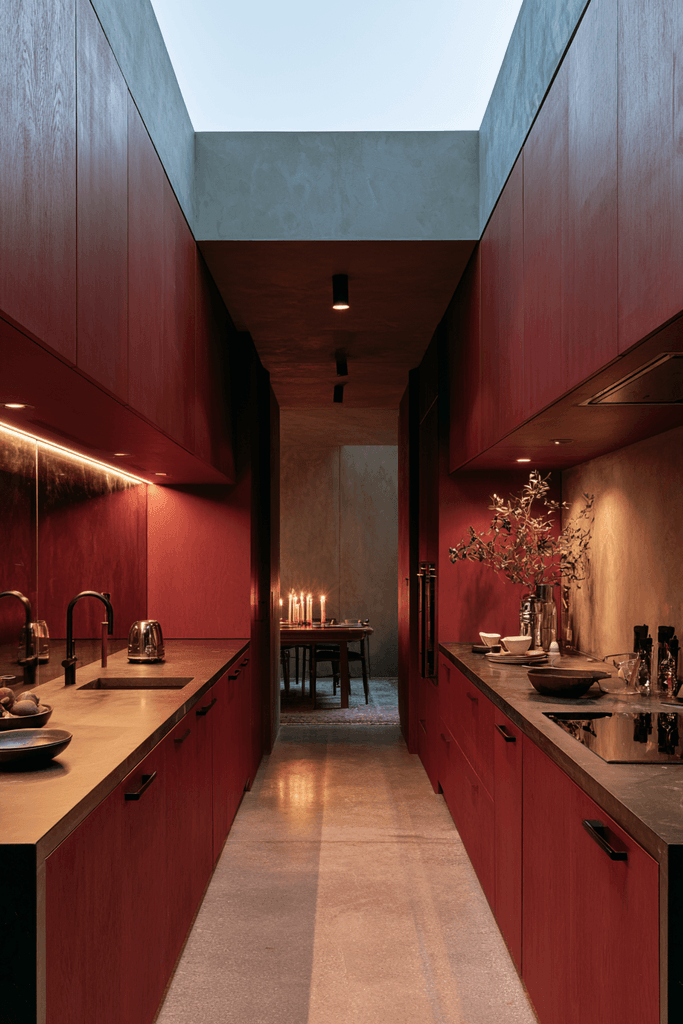
- Use mirrored glass backsplashes in narrow kitchens to create an illusion of depth and reflect ambient light sources.
- Commit fully to a saturated colour in galley layouts — half-measures feel timid; full-height cabinetry in a single bold hue is more effective.
- Contrast warm cabinetry with cool concrete countertops to prevent the palette from feeling oppressive.
- Install a skylight to introduce natural overhead light that evolves through the day without requiring window space on walls.
- Use matte black hardware consistently throughout a colourful kitchen to act as a unifying anchor.
6. Dark Olive Green, Raw Concrete, and Industrial Steel Shelving
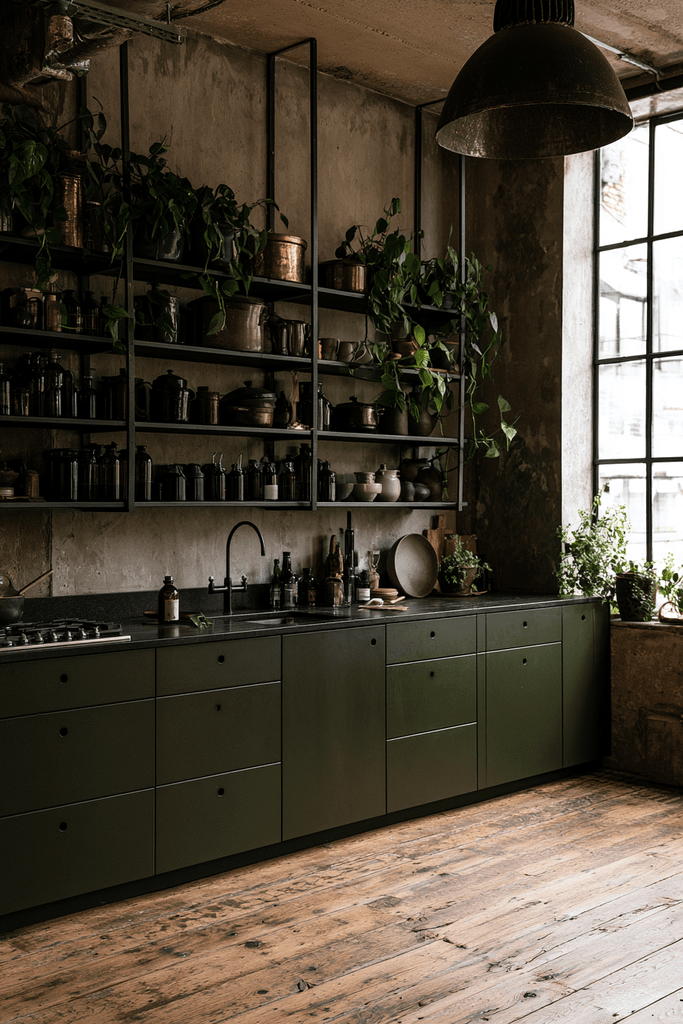
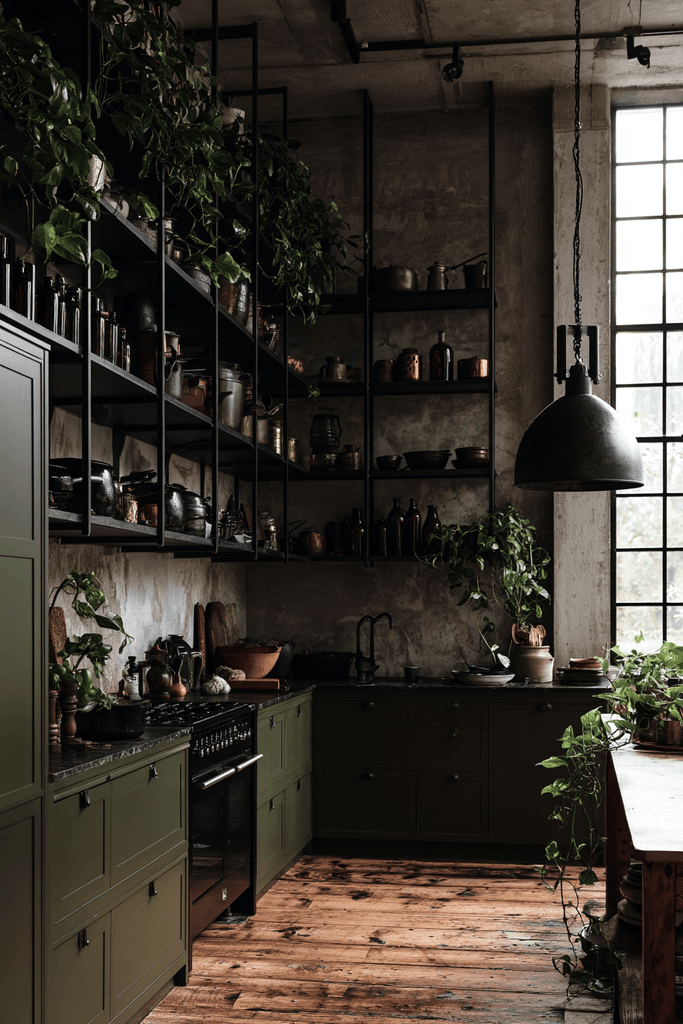
This design is for those who love kitchens that feel like they have been assembled over decades — layered, lived-in, and unapologetically real. Dark olive green cabinetry meets raw concrete walls and ceiling-height black steel shelving stacked with vintage cookware, dark glass bottles, and trailing pothos plants. The botanicals are critical: greenery softens the industrial hardness of steel and concrete, adding an organic, breathing quality to the space. An oversized blackened steel pendant anchors the cooking zone with authority, while worn oak flooring — knotted, patinated, irreplaceable — grounds the entire composition. This is a kitchen for people who cook seriously and live beautifully.
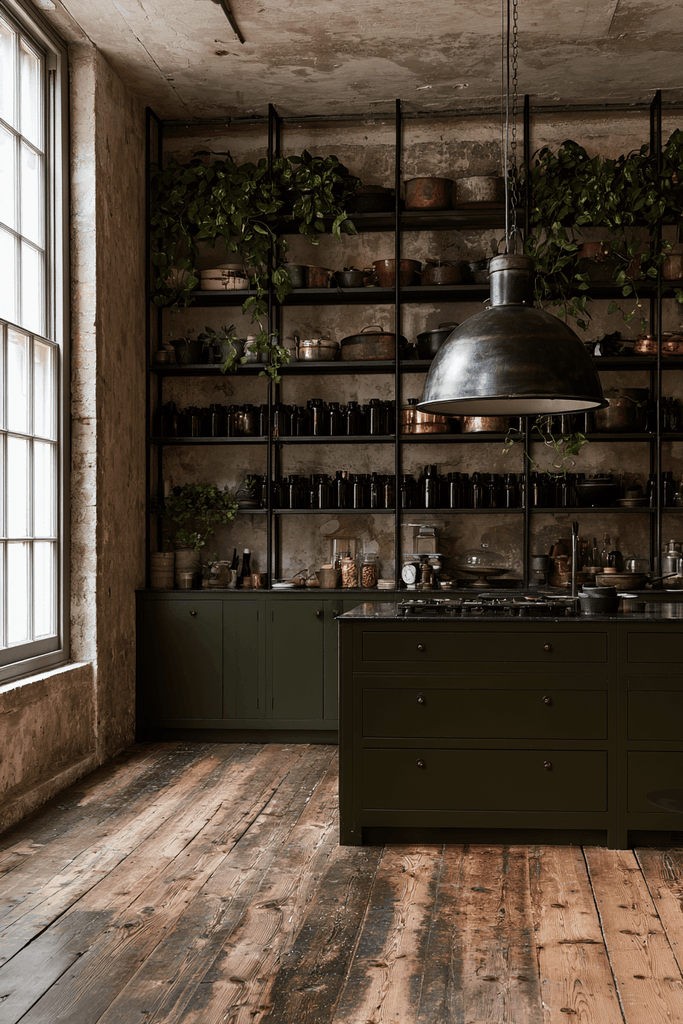
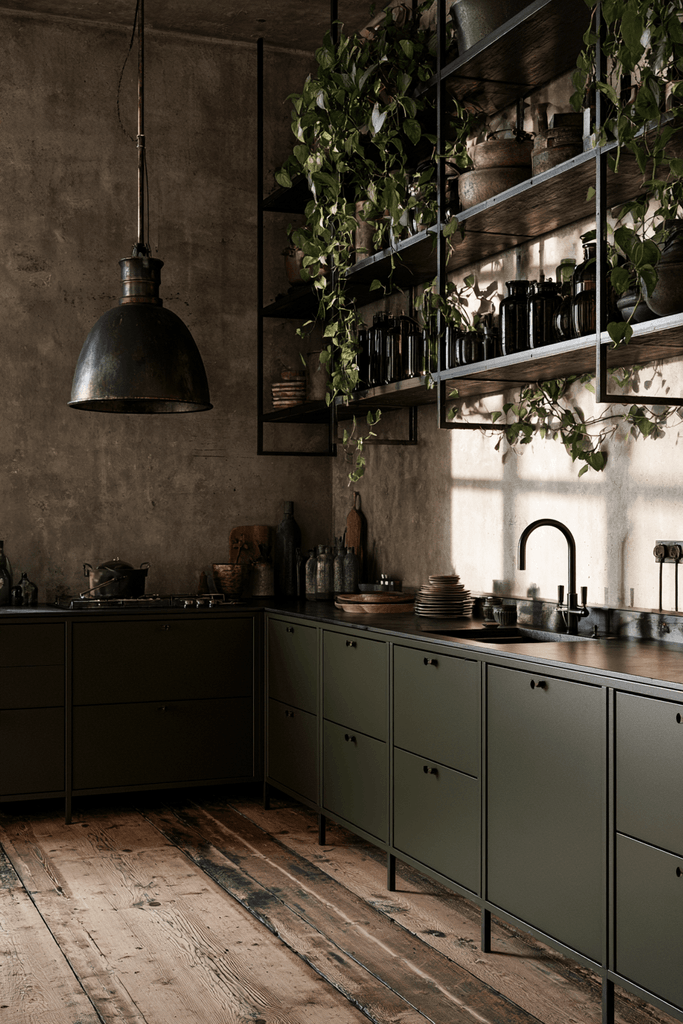
- Introduce trailing plants on high shelving to soften industrial elements and add organic movement to rigid geometry.
- Source worn, knotted oak flooring rather than new — the natural patina contributes character no new product can replicate.
- Choose blackened steel pendants that complement both the industrial shelving and the olive cabinetry.
- Stack shelving with a mix of functional and decorative objects — vintage cookware alongside dark glass bottles reads as curated, not cluttered.
- Allow raw concrete walls to remain unsealed for maximum textural authenticity in an industrial moody kitchen.
7. Period Home Moody Kitchen: Black Cabinets, Arched Window, and Heritage Warmth
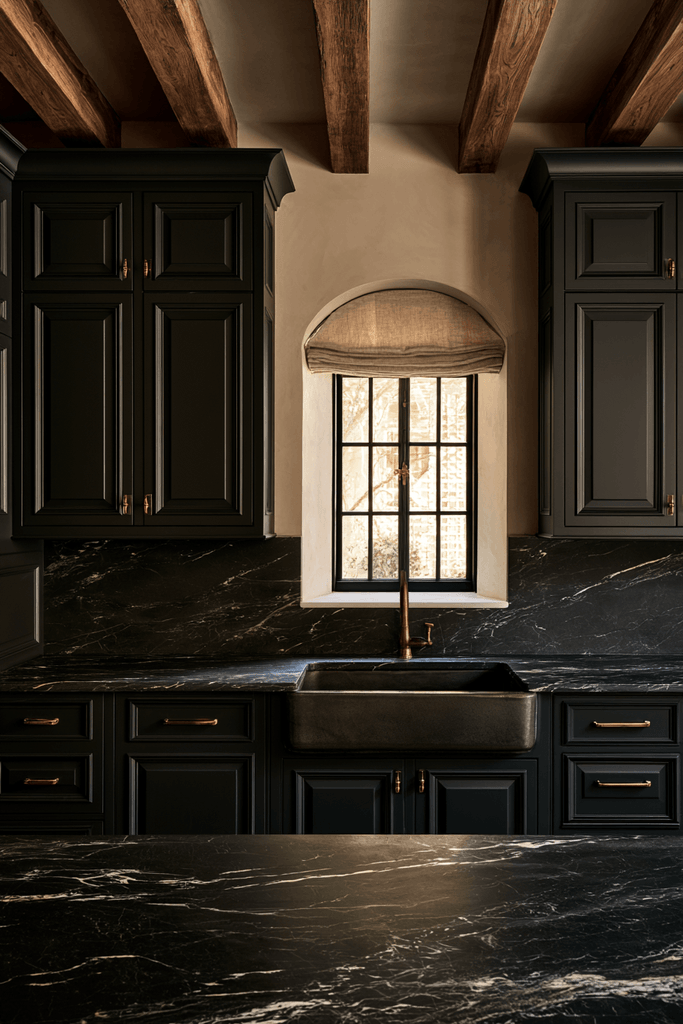
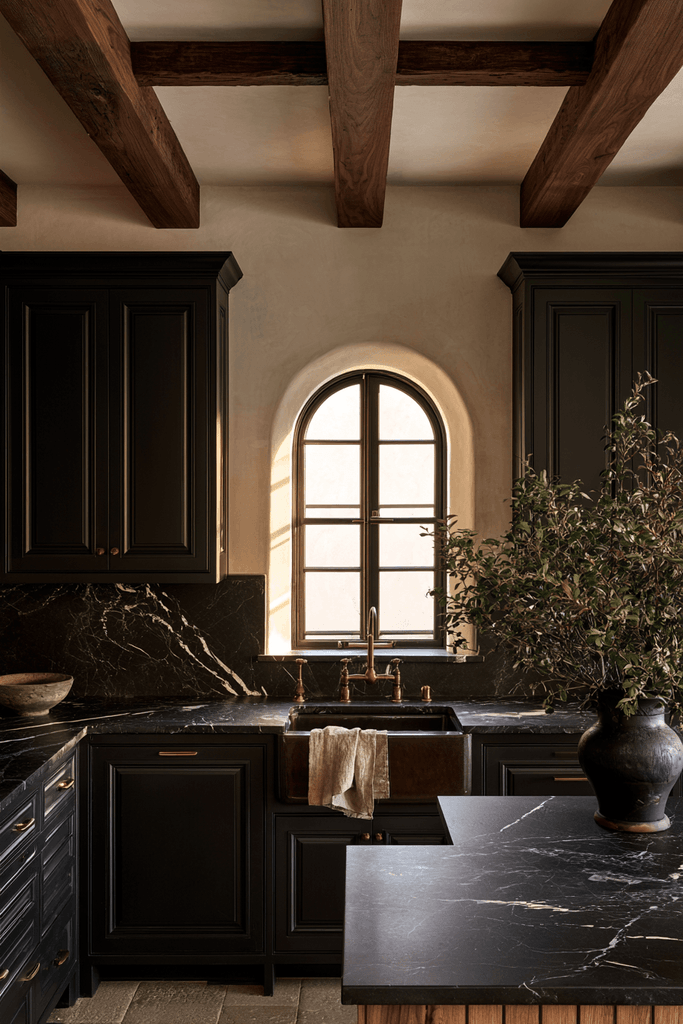
In a period home, the moody kitchen earns its atmosphere through the building’s own history. Original exposed ceiling beams in dark walnut stain command attention from above, their aged grain providing a ceiling texture that no modern material can fabricate. Below, matte black painted cabinets with traditional raised panel doors and oil-rubbed bronze hardware pay homage to the home’s heritage while maintaining a contemporary design discipline. The countertop — honed Calacatta black marble with dramatic white veining — brings a sense of geological drama that feels entirely appropriate in a space this considered. A small arched window draped in linen frames a view while golden hour light floods the workspace with warmth, turning the marble into something almost luminous.
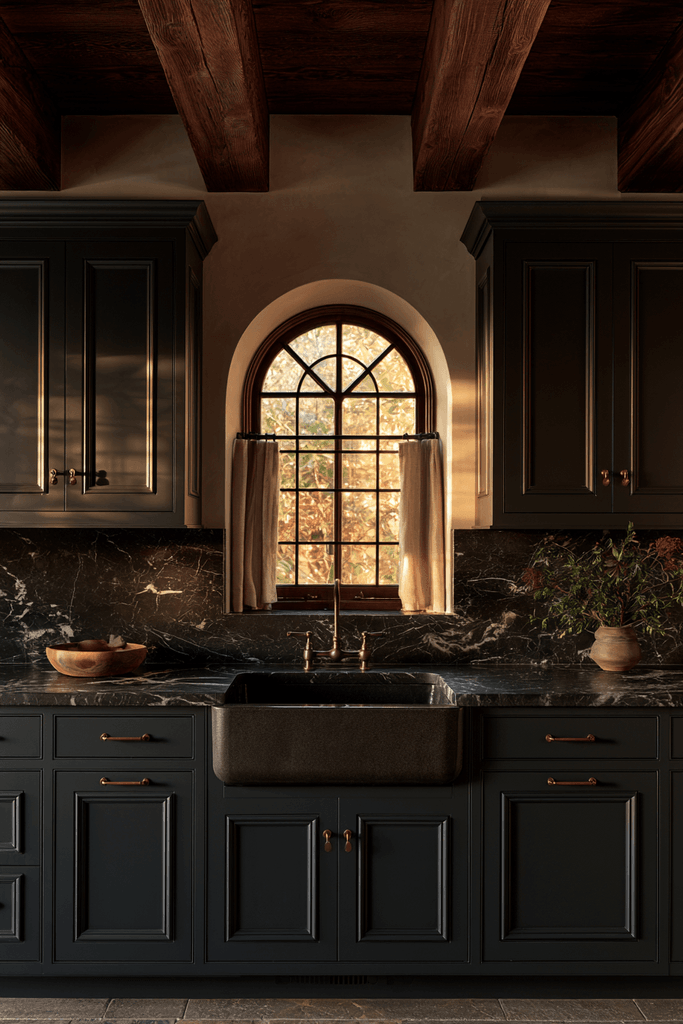
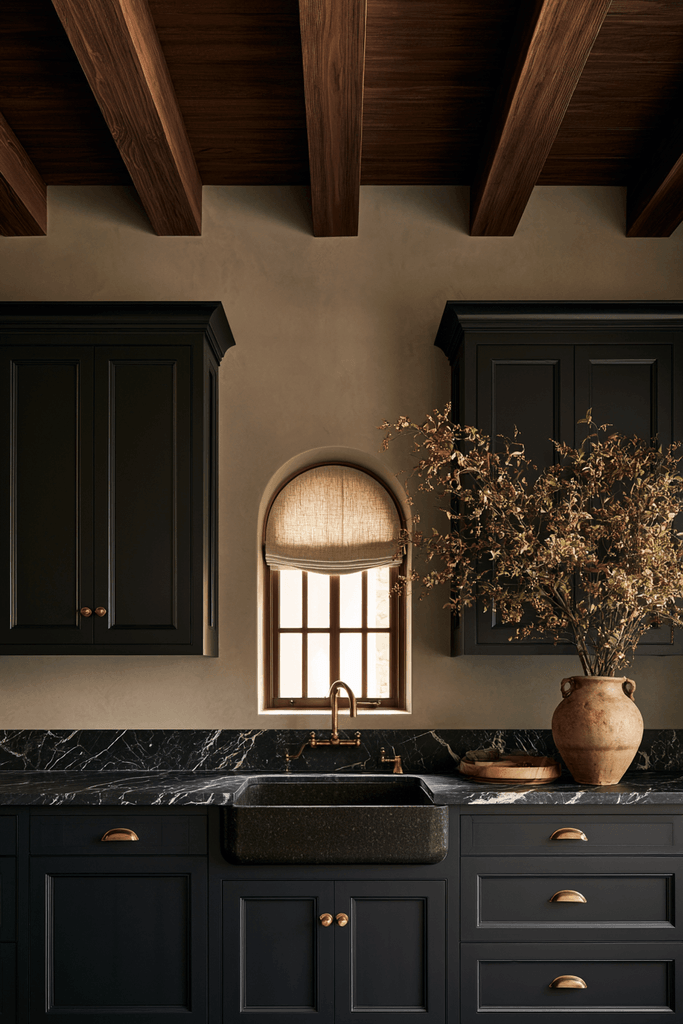
- Retain and enhance original beams by staining them in dark walnut — they provide a ceiling texture money cannot buy.
- Choose raised panel cabinet doors in period homes rather than shaker — the detail resonates with the architecture.
- Use oil-rubbed bronze hardware for its aged warmth; it develops beautifully and suits heritage materials.
- Select Calacatta black marble for high drama with white veining that prevents the dark scheme from closing in.
- Dress small windows in linen rather than blocking them — natural light at golden hour is the best decorative layer in any kitchen.
8. Moody Breakfast Bar With Chalkboard Wall and Smoky Tile
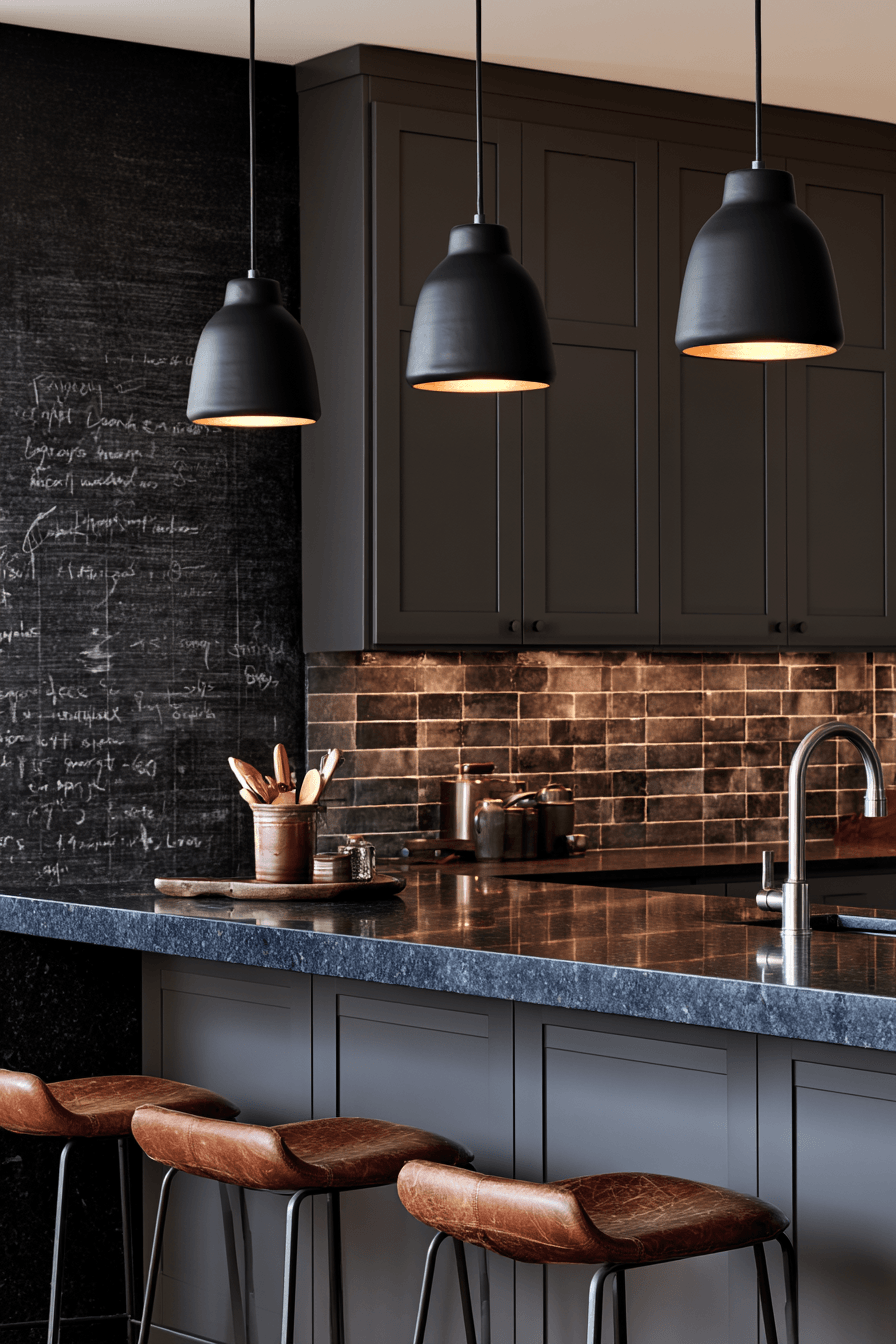
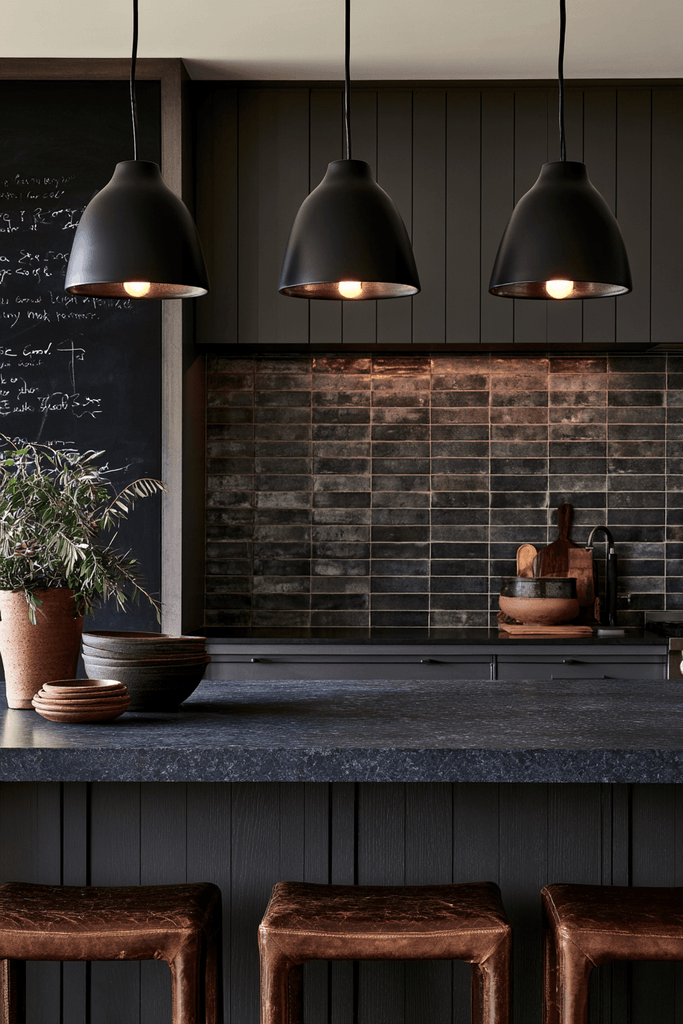
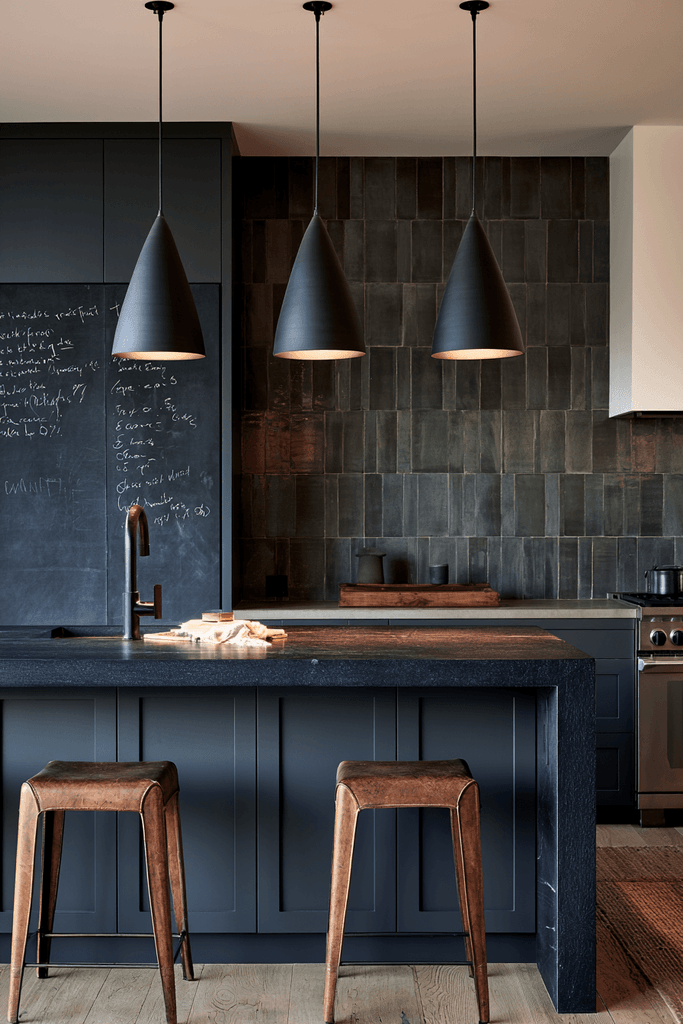
A breakfast bar configuration has rarely looked this considered. A waterfall edge midnight blue quartz countertop extends seamlessly from dark grey shaker base cabinets, its continuous surface making the island feel monolithic and sculptural. Three matte black pendant lights of distinct, sculptural form hang above, their shapes chosen as much for their visual interest as their illumination. Worn leather bar stools introduce texture and a sense of easy comfort. The chalkboard wall to one side — partially annotated with grocery lists in chalk — is a stroke of genius: it adds lived-in character that no designed element can manufacture. The smoky charcoal handmade tile backsplash, with its subtle glaze variation, ties the material story together beautifully.
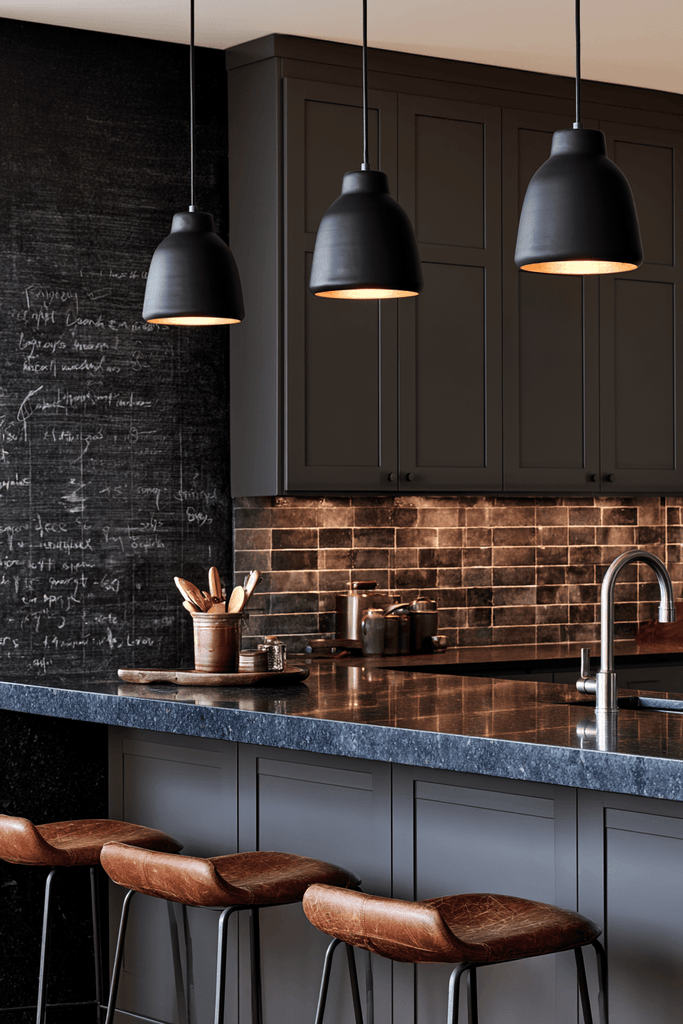
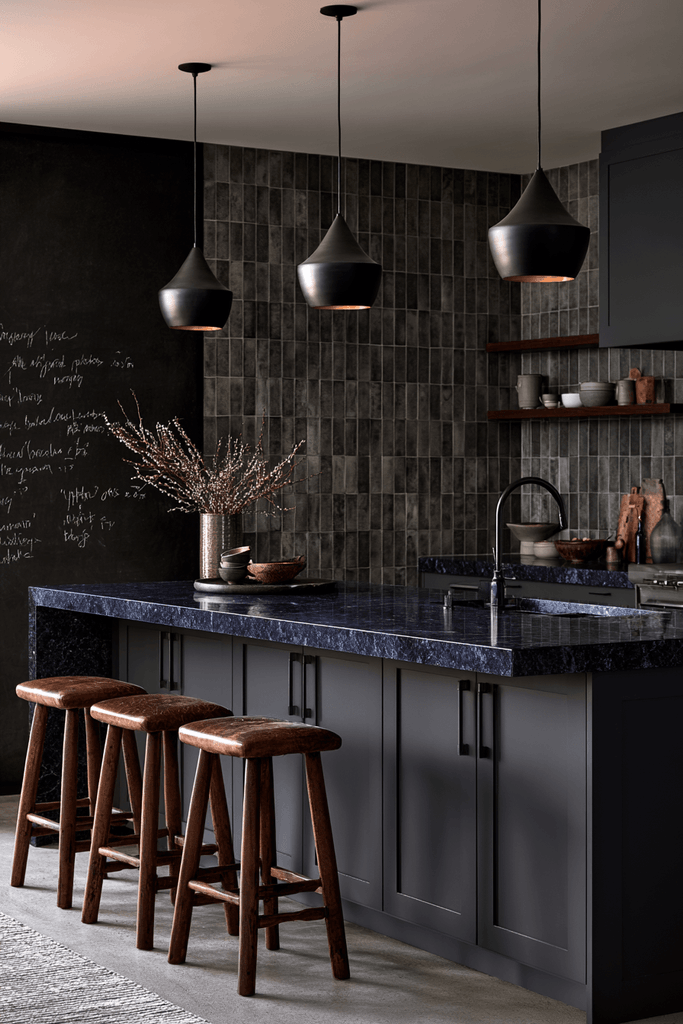
- Choose waterfall edge countertops to give a kitchen island a furniture-like, architectural quality.
- Select sculptural pendant lights rather than purely functional ones — above a breakfast bar, they are as decorative as art.
- Incorporate a chalkboard wall for practical annotation and the authentic, human imperfection it introduces.
- Use handmade tiles with glaze variation in the backsplash — the subtle irregularity catches light in ways no factory tile achieves.
- Specify worn leather stools over new — the patina adds warmth and a sense of time that moody kitchens need.
9. Deep Plum Apartment Kitchen: Compact, Dramatic, and Efficient
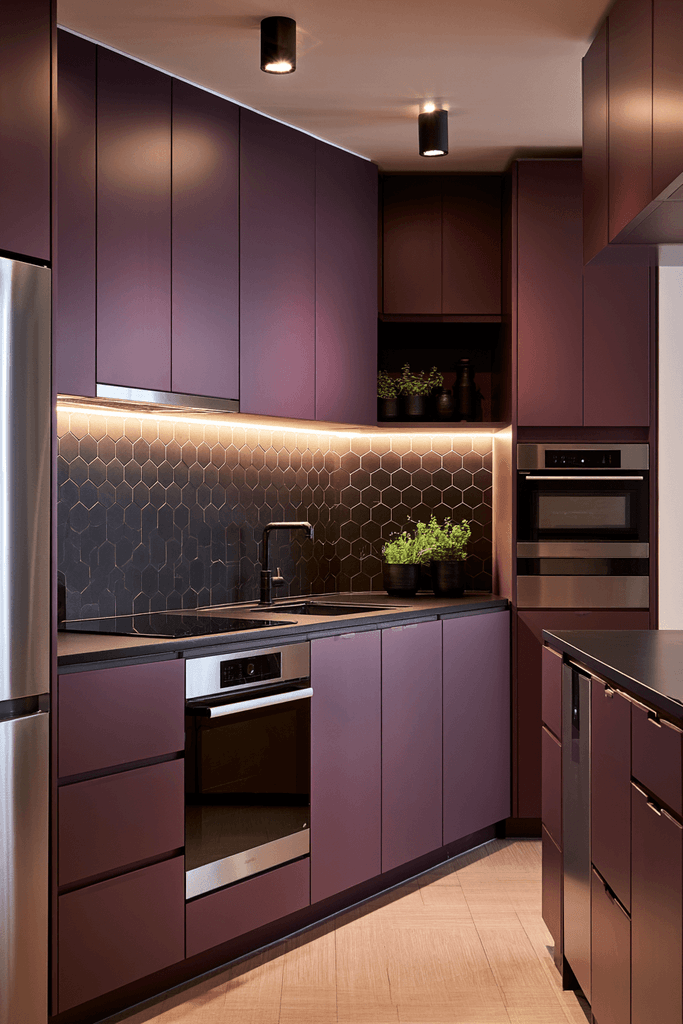
This design proves definitively that moody kitchens are not the preserve of large homes. A compact apartment kitchen in deep plum maximises storage through floor-to-ceiling cabinetry with integrated push-to-open drawers — hardware-free for a seamless, enveloping effect. Panel-ready stainless steel appliances disappear into the cabinetry run, maintaining the visual unity of the plum envelope. Dark hexagonal tiles with a matte finish create a backsplash that adds pattern without colour disruption. A tiny herb garden growing in black ceramic pots on a single open shelf introduces life and greenery — a small act of nature that makes the space feel inhabited and warm. Warm white under-cabinet lighting provides functional illumination while keeping the palette intact.
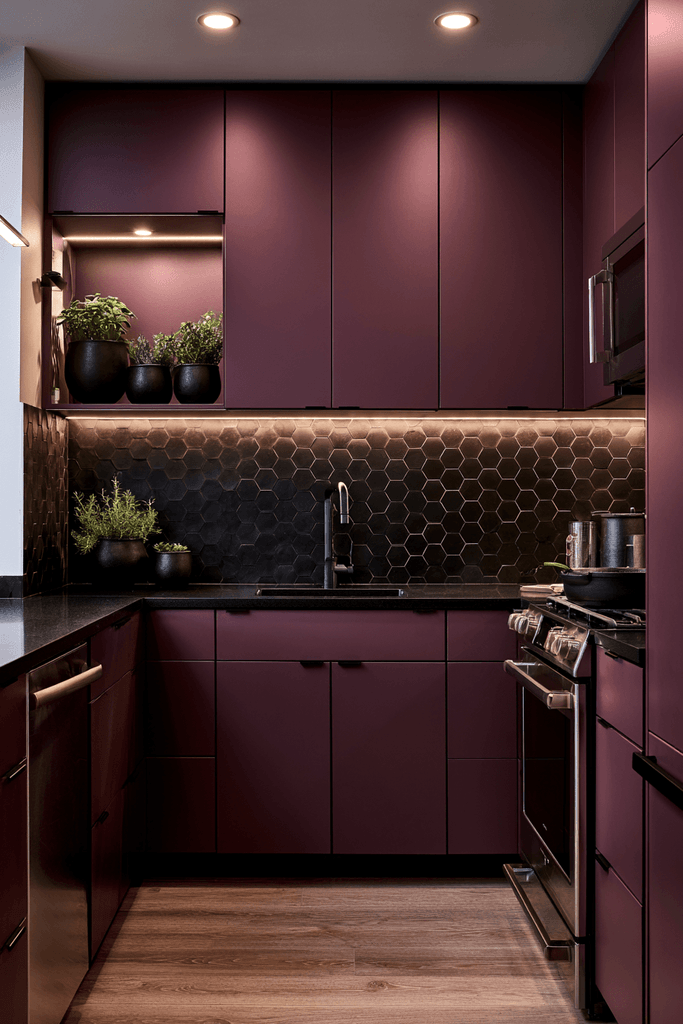
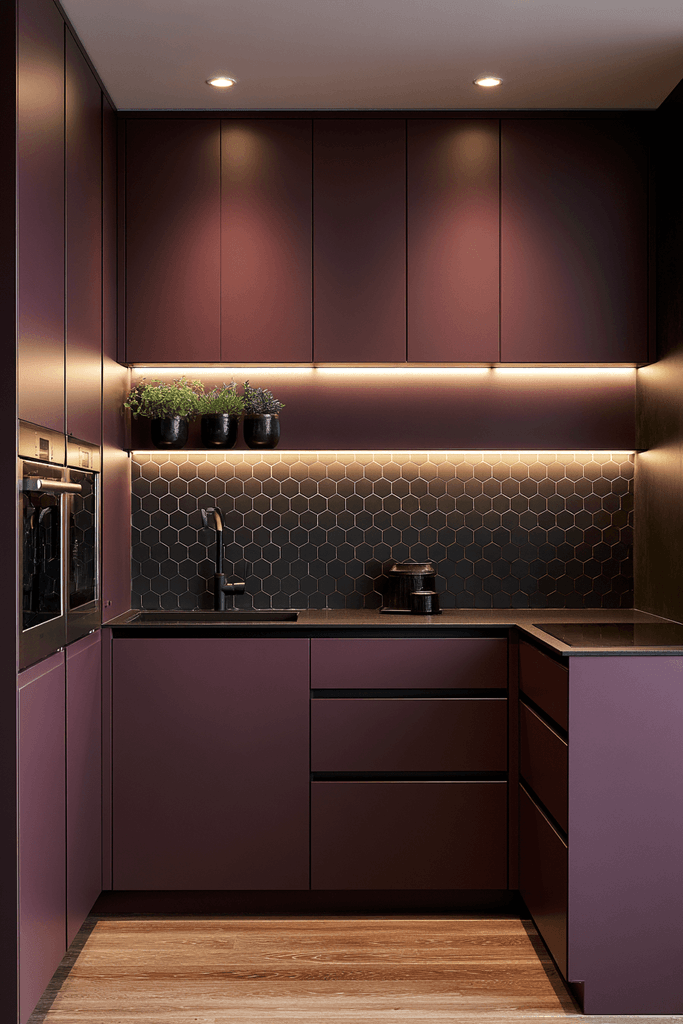
- Use push-to-open cabinetry in compact kitchens to eliminate hardware and create a seamless, enveloping aesthetic.
- Specify panel-ready appliances so refrigerators and dishwashers disappear into the cabinetry — visual continuity maximises the moody effect.
- Choose dark hexagonal tiles with matte finishes for a backsplash that adds geometry without disrupting the colour palette.
- Maintain a small herb garden on open shelving — the green contrast against deep plum is one of the most effective and affordable styling moves possible.
- Install warm white under-cabinet LEDs rather than cool white — colour temperature dramatically affects how dark cabinetry reads.
10. Loft Moody Kitchen: Blackened Brick, Dark Ash, and Blue Hour Magic
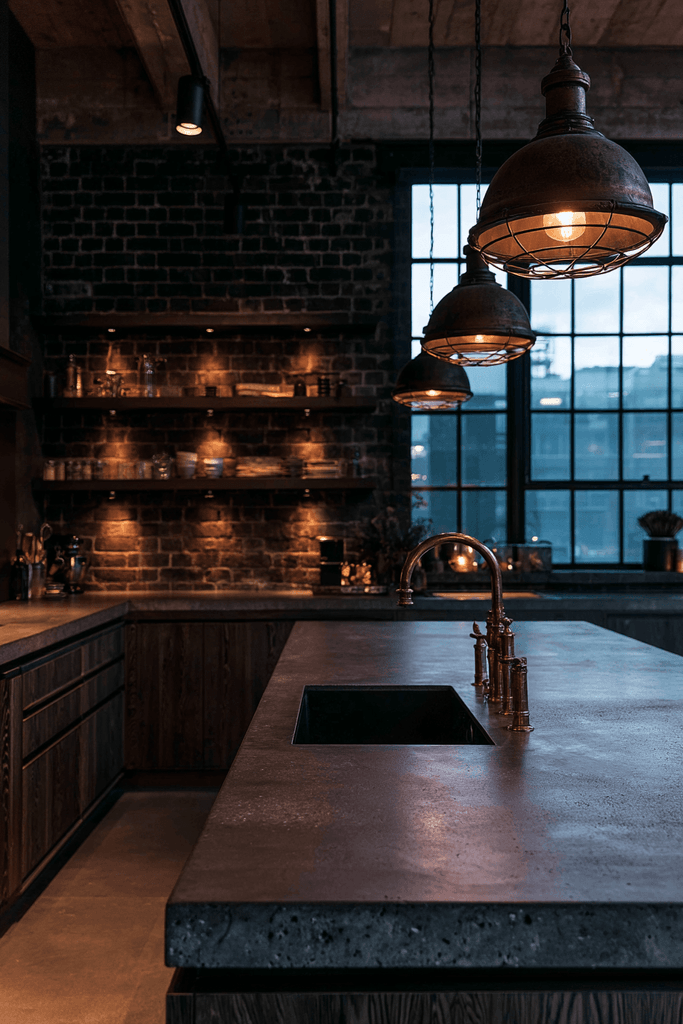
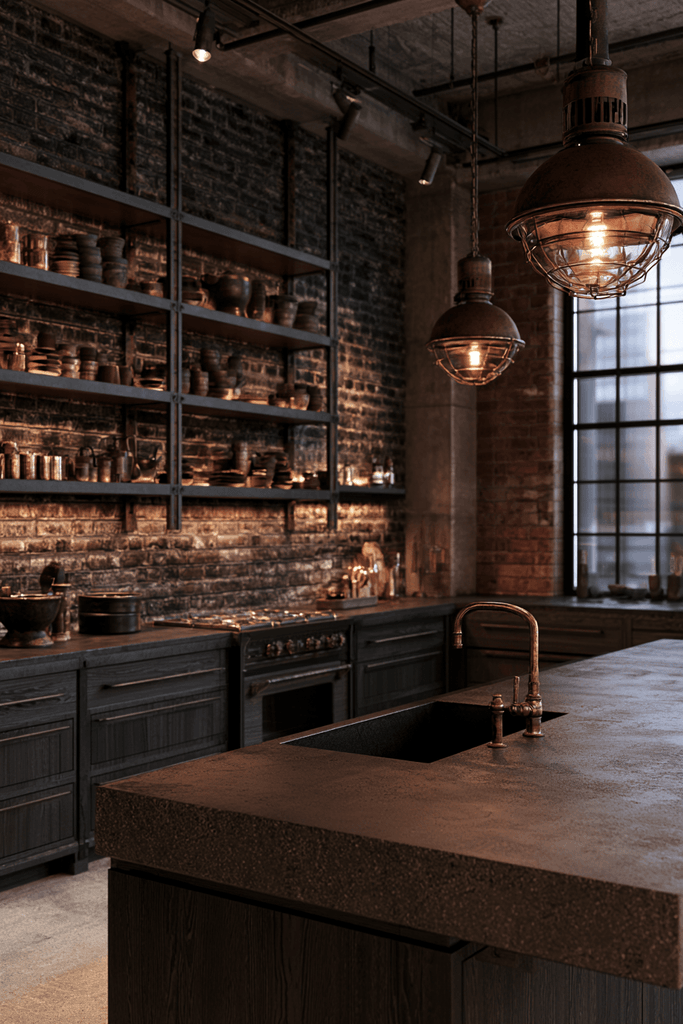
The final design is perhaps the most cinematic of all — a loft moody kitchen where every material has been chosen for its honesty and texture. Raw steel open shelving is bolted directly to blackened brick walls, its industrial utility transformed into something deeply atmospheric. Dark ash wood base cabinets provide warmth at counter height, their natural grain visible beneath the finish. An aged patina brass faucet over a black composite sink is the kind of detail that reveals itself slowly — the more you look, the more you appreciate it. The island top in poured-in-place concrete with a rough aggregate finish is tactile and completely unique. Antique bronze cage pendants hang low, and at blue hour, when warm artificial light from within meets the cool ambient glow from factory-style windows, the kitchen becomes genuinely magical.
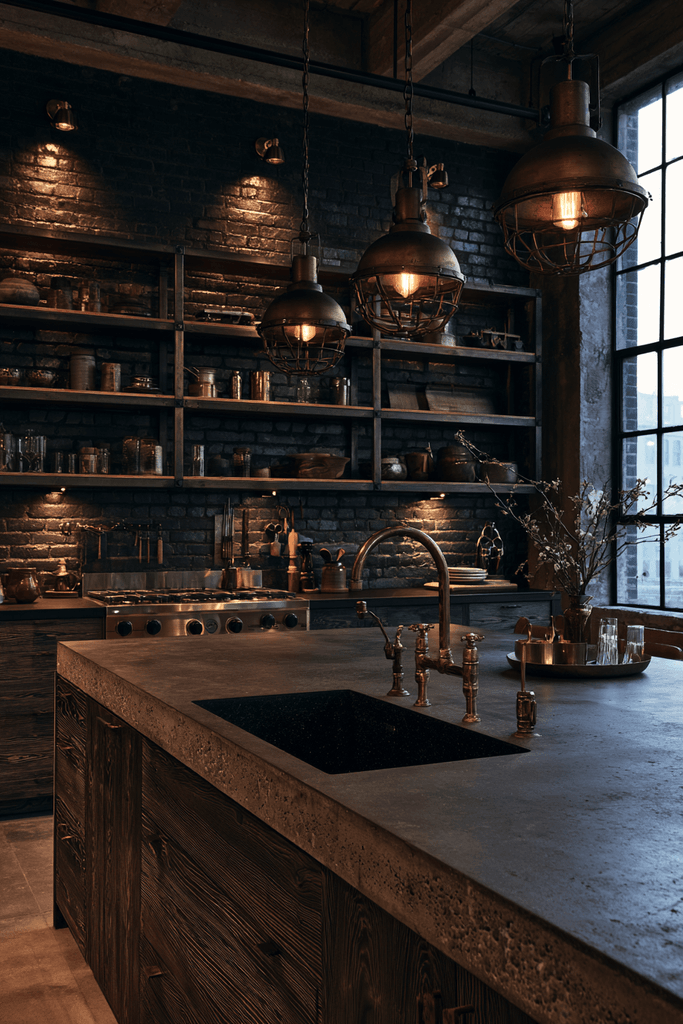
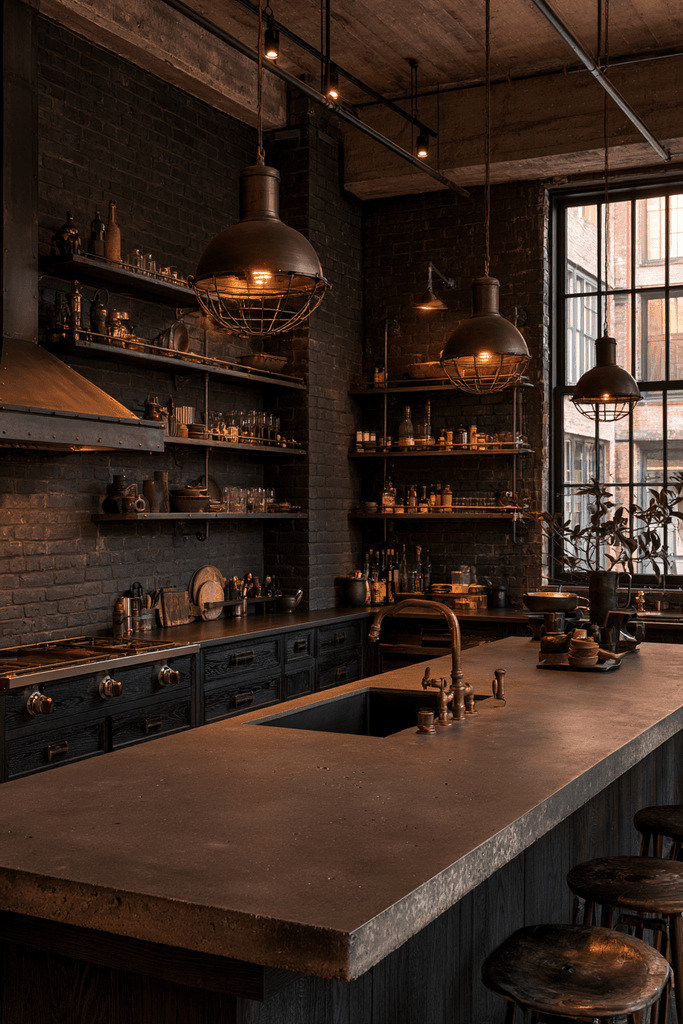
- Mount steel shelving directly to brick rather than using brackets on drywall — the raw connection reads as authentic and industrial.
- Choose dark ash wood over walnut or oak in loft settings — its cooler tone suits the industrial context perfectly.
- Specify a poured-in-place concrete island for a surface that is truly one-of-a-kind and develops character with use.
- Position antique bronze pendants low over the island — the lower the pendant, the more intimate and dramatic the pool of light.
- Photograph or experience your kitchen at blue hour — the interplay of warm interior light against cool exterior ambient light is a moody kitchen’s finest moment.
Why These Moody Kitchen Ideas Represent the Best in Dark Interior Design
The ten designs explored in this article collectively represent the full spectrum of what moody kitchen design can achieve. From the dark kitchen aesthetic of charcoal and brass to the heritage warmth of a period home renovation, each concept demonstrates a different facet of the same fundamental principle: that shadow, depth, and carefully chosen materials create more atmosphere than any amount of brightness ever could.
These are dark kitchen ideas built on a foundation of material integrity — black kitchen cabinets, leathered marble, handmade zellige tile, aged brass, raw concrete, and worn oak flooring all appear because they earn their place through texture, history, and authentic character. The moody kitchen aesthetic explored here also embraces colour bravery: forest green kitchen cabinets, navy blue kitchen islands, deep plum cabinetry, and burgundy galley kitchens prove that the dark kitchen palette extends far beyond black and grey.
Lighting is the unsung hero of every design featured. Whether it is vintage Edison bulbs casting amber warmth over a zellige backsplash, a skylight introducing cool daylight into a burgundy galley, or the cinematic blue hour glow of a loft space, kitchen lighting ideas for moody spaces are always deliberate, always layered, and always atmospheric. The dramatic kitchen design philosophy at the heart of this article holds that light is most beautiful when it exists in conversation with shadow — and that the best dark kitchen ideas are those that understand this intimately.
For renters and homeowners working with smaller footprints, the compact designs — the deep plum apartment kitchen and the galley in burgundy — demonstrate that small moody kitchen ideas are entirely achievable without compromise. Drama does not require space; it requires intention.
Conclusion
A moody kitchen is not simply a dark kitchen — it is a deeply considered space where every choice, from the finish on the cabinet doors to the temperature of the pendant light, serves a larger atmospheric vision. The ten designs explored in this article offer a roadmap for anyone ready to move beyond safe, predictable interiors and embrace something more personal, more dramatic, and more enduring. Whether you are drawn to the heritage warmth of raised panel cabinetry and oil-rubbed bronze, the industrial honesty of blackened brick and dark ash wood, or the colour bravery of deep plum or burgundy, there is a moody kitchen concept here that speaks to you. Start with one bold decision — a cabinet colour, a tile choice, a pendant — and let the atmosphere build from there. The most unforgettable kitchens are the ones that feel like they could only ever belong to one person. Make yours one of them.